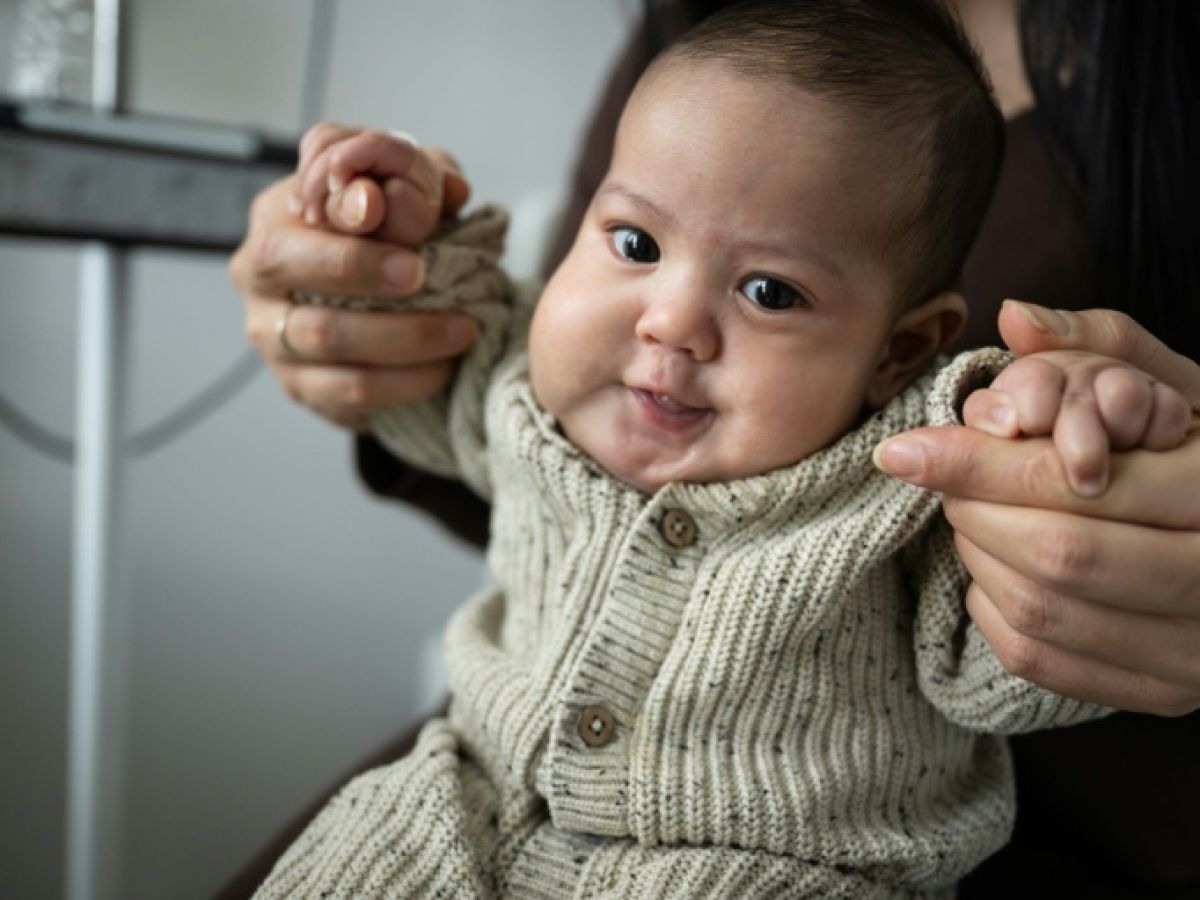
"An exceptional treatment that saved this little boy": a baby who was suffering from a rare vascular tumor and at risk of dying was treated in utero, a first for this pathology.
Towards the end of the seventh month of pregnancy, the tumor (Kasabach Merritt syndrome), which presents a very high risk of death in utero, is detected on the fetus at the maternity hospital in Mulhouse.

A mass present at the neck risked "compressing the breathing" of the baby, explained Dr. Chris Minella, referring physician at the Multidisciplinary Prenatal Diagnosis Center of the University Hospitals of Strasbourg, on Monday, during a press conference at the Woman-Mother-Child Hospital in Mulhouse (Haut-Rhin).
The swelling was growing very quickly, reaching the entire base of the baby's face.
After establishing the diagnosis, the reference center for superficial vascular anomalies of the Hospices civils de Lyon, a specialist in these rare pathologies, proposed to use prenatal treatment with Sirolimus, under the direction of Professor Laurent Guibaud.
"It was the only way to save this baby," Professor Guibaud told AFP by telephone.
– “The only way” to save him –
Kasabach-Merritt syndrome is "a very aggressive tumor. Its particularity is that it aspirates platelets, platelets being an important element for coagulation. The baby ends up with a very low platelet count and is subject to hemorrhages that can be fatal," according to Professor Guibaud.

Little Issa showed "signs of suffering suggesting that his blood clotting may have begun to malfunction."
In agreement with the doctors and the family, it was decided to administer antenatal treatment with Sirolimus, an anti-angiogenic drug (which limits the proliferation of blood vessels). The drug, administered orally to the mother, crosses the placental barrier and reaches the fetus, thus slowing the growth of the tumor.
"This is the first time this treatment has been used prenatally to treat a vascular tumor of this type," emphasizes Professor Guibaud.
On November 14, 2025, Issa was born by cesarean section at the Hautepierre maternity hospital in Strasbourg. The size of the tumor had decreased, and he did not need to be intubated to breathe. However, his platelet count was quite low, requiring a platelet transfusion.
"This is an exceptional treatment that has saved this little boy, whose malformation has been stabilized," says Dr. Alexandra Spiegel-Bouhadid, hematologist in the pediatric department of GHR Mulhouse Sud-Alsace, who has been following Issa since his birth.
This prenatal therapy, which can treat large, potentially lethal vascular malformations, was unveiled in August by the Reference Center for Superficial Vascular Anomalies (CRMR AVS) of the Hospices Civils de Lyon.
It had already been used to treat other types of malformations but not for the syndrome from which Issa suffers.
"Now, the whole challenge is to optimize this prenatal care to offer it to other vascular lesions of this type," explains Professor Guibaud.
Today, 3-month-old Issa has a mass on the lower part of his face but is a smiling and alert baby. "Despite his tumor, he is a normal child, he eats well, he is growing well," rejoices his mother Viviane, 34.
The infant was able to return home a month after his birth and receives regular follow-up care at the hospital in Mulhouse. He continues treatment with Sirolimus.
"Seeing him every week, I can tell you that he is doing very well. He holds his head up very well, he gives beautiful smiles," notes Dr. Alexandra Spiegel-Bouhadid.
"It was very stressful," testifies the infant's mother, "but we did well to keep hope: he is here."
 English
  French