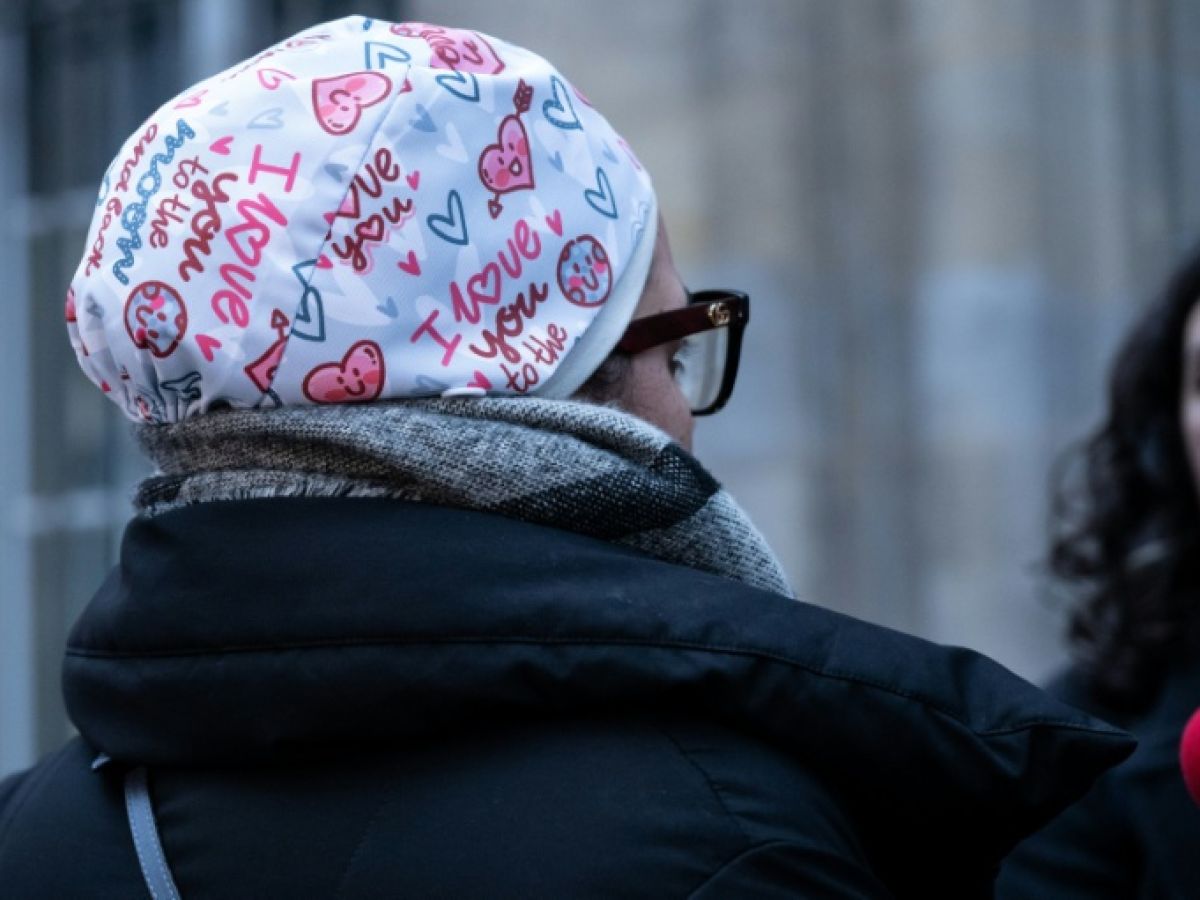
A nurse from La Pitié-Salpétrière (AP-HP) challenged her dismissal and removal from the civil service on Tuesday in summary proceedings before the administrative court for repeatedly refusing to remove her surgical cap, a head covering frequently used in the hospital.
Majdouline B., a nurse since 2018 in this hospital of the Assistance publique-hôpitaux de Paris, was dismissed on November 10, 2025. For a year, management had accused her of wearing daily and in all circumstances a cap, protective equipment made of fabric, usually worn in the operating room or in intensive care.

During the year, she received six summonses and a reprimand, culminating in a disciplinary hearing in October.
Initially, "the AP-HP criticized him for wearing this head covering for reasons related to his supposed religious beliefs," thus considering "that he was undermining the principle of neutrality of public services" and contravening the secularism guide distributed to the teams, Majdouline B.'s lawyer, Lionel Crusoé, indicated before the court.

But Majdouline B. never claimed any religious affiliation, simply stating that wearing this equipment was a matter of "her private life." The argument of secularism "was ultimately dismissed," he added.

The AP-HP sanctioned her because she "refused to obey a rule" justified by "hygiene" issues, which "prohibits wearing the cap continuously, in areas where it is not prescribed", in particular a cap "that is not provided by the establishment", "entering and leaving" the premises, indicated the AP-HP lawyer, Ms. Violaine Lacroix.
The AP-HP bases its recommendations in particular on 2014 recommendations from the committee for the fight against nosocomial infections.
But, according to Ms. Crusoé, "no law, no regulation" and "no objective data" prohibit the wearing of the cap in the internal medicine department where she worked.
– A “discrimination” –
Majdouline B. "deserves the recognition and admiration of her colleagues" and "was on the front lines during the health crisis," argued Mr. Crusoé. He asserted that at the AP-HP (Paris Public Hospitals), other women wear the cap, particularly in cases of alopecia or after cancer.

Majdouline B., for her part, sees this dismissal as "discrimination".
"I am being dismissed for my appearance and not for my professional skills," she told AFP, asserting that she had been wearing the cap since she was hired and that "during Covid, everyone wore caps, masks, and gowns."
The verdict is expected in one to two weeks.
Around fifty people – colleagues, union members or political activists – gathered in front of the court, in support of Majdouline B. and the “many other caregivers” who, according to them, were victims of a widespread “hunt for scraps of fabric”.
"We have identified 20 colleagues involved" at La Pitié-Salpétrière, nine of whom "have finally left," cases "in 16 hospitals in the Paris region" and others "in Lyon, Marseille, Rennes…," denounced Blandine Chauvel, social worker and representative of Sud.
These women are "summoned, questioned about their private lives," sometimes forced "to provide a medical certificate" to justify possible alopecia, and meanwhile "in the services, there is a shortage of staff," she added.
On social media, several nurses have filmed themselves in recent days wearing a cap in support of the professionals sanctioned by their management.
“The skullcap is neither a religious symbol, nor even less a proselytizing symbol. (…) In addition to blatant Islamophobia,” this type of case is “extremely serious since it endangers health services,” denounced LFI MP Mathilde Panot during a press briefing at the National Assembly.
 English
  French