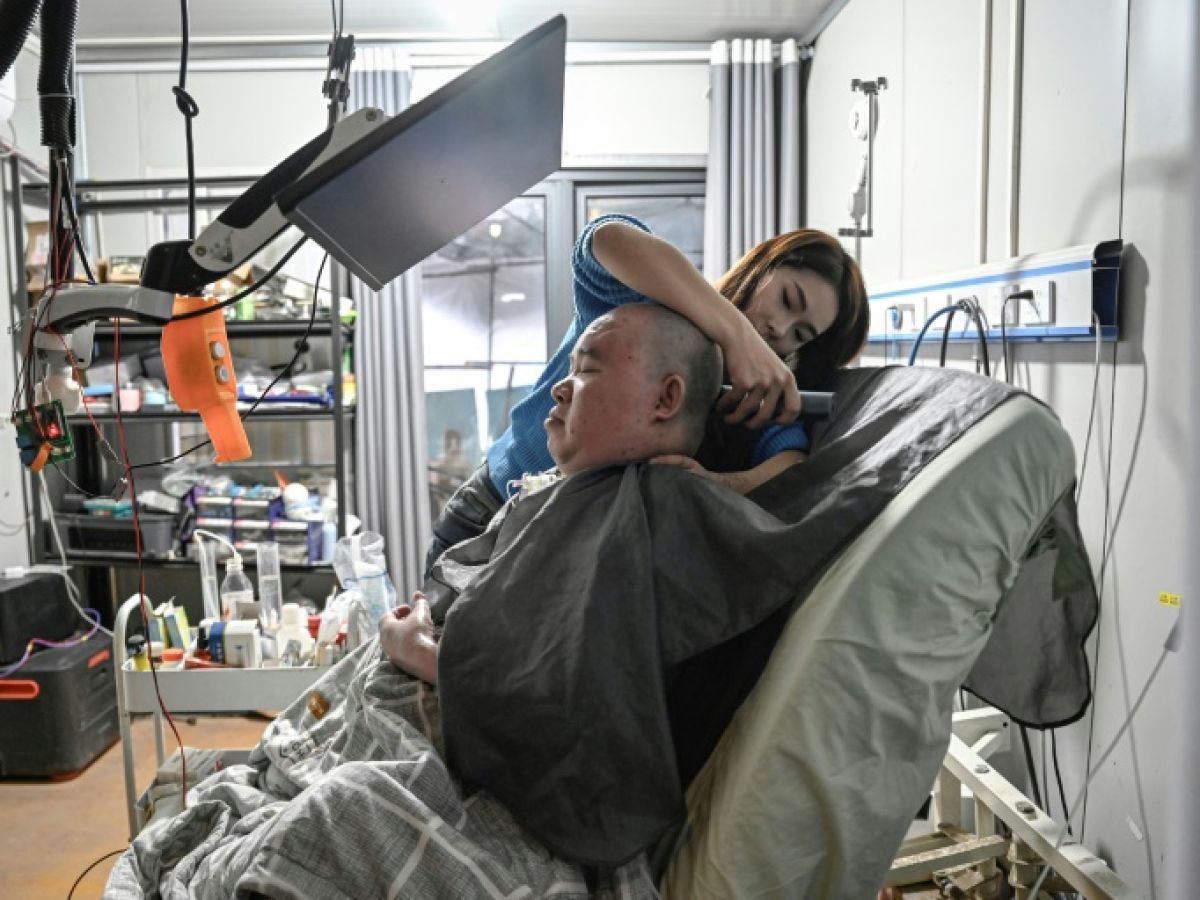
Tetraplegic, bedridden in a medicalized prefabricated building in the Chinese countryside, 36-year-old Li Xia can only move one finger and one toe, yet he manages a high-tech farm using sensors, cameras and a computer.
With his trachea connected 24 hours a day to an artificial respirator essential to his survival, suffering from an incurable genetic disease, he grows celery hydroponically with the help of his 62-year-old mother.
From his bed, 10 meters from his four greenhouses, he stares at the computer screen hanging above him on an articulated arm.
"Thanks to a program I coded and via a mobile app, I monitor several data points: temperature, humidity, nutrient solution concentration and its pH," explains Li Xia.
"And with the cameras, I'm checking if the water pump is working or if the fans are running."
To move the cursor on the screen, he uses a ball mouse (a "trackball") with his only working finger.
"To click, I use a flex sensor attached to my toe," Li Xia, who lives in the village of Shiping, near the metropolis of Chongqing (southwest), told AFP.
Duchenne muscular dystrophy (or myopathy) (DMD), from which he suffers, is a genetic disease that almost exclusively affects men, at a rate of one male birth per 5,000.
Over the years, muscles weaken, falls become frequent, then paralysis increases, affecting heart activity and breathing.
Li Xia, who was once wheelchair-bound, suddenly deteriorated in 2020 when he was 30 years old. He fell into a coma, became incontinent, and quadriplegic.
"I was devastated," he recalls.
"But after a few months, I pulled myself together and looked for things that made sense."
– “Mastermind” –
He discovered hydroponics, an innovative growing method where vegetables grow not in soil, but in a water solution enriched with essential nutrients.

Partially automated, it requires little manpower, allows for fine control of crops and ensures good yields.
“I grew up in the countryside, so I’ve always been in contact with seeds, soil, and vegetables. I also love digital technologies and programming. I realized I could combine the two,” he says.
"I also thought it was a promising niche. And that if I succeeded, it would allow me to fulfill a dream, but also to earn money and improve our living conditions."
Li Xia taught himself computer programming and printed circuit board design. His mother and sister supported him. In 2022, they moved into this modular home.
His mother does all the manual work. He explains to her what needs to be done and supervises her actions in the greenhouses via video link using a smartphone.
"She is my arms and legs, and I am her thinking head," he summarizes.
She cooks, operates drills and angle grinders, measures fertilizers, installs equipment, connects cables.
– Stephen Hawking –
Not to mention the care given to her son day and night, such as cleaning the cannula installed in his trachea to remove the mucus.

"I don't have time to breathe," explains his mother, Wu Dimei. Even with the help of her daughter who regularly comes to bathe her brother, she only sleeps between three and five hours a night.
"But it's worth it," emphasizes Ms. Wu, who is divorced. "We may not look it, but our family is quite happy."
Li Xia's case is reminiscent of that of other patients with severe neuromotor disorders, such as the British physicist and cosmologist Stephen Hawking, who suffered from Charcot's disease, was wheelchair-bound, and could only communicate through a voice synthesizer.
Or Jean-Dominique Bauby, former editor-in-chief of the French magazine Elle, paralyzed after a stroke and author in 1997 of the book "The Diving Bell and the Butterfly" dictated by blinking his left eye - the only movement he still controlled.
Li Xia's celery is sold to a local supermarket chain.
"We are not yet making a profit" and "my dream is to expand this farm, to make it a successful business, to produce more and earn more," proclaims Li Xia.
"My motivation is to see our vegetables grow, be harvested, sold, and end up on people's plates."
 English
  French