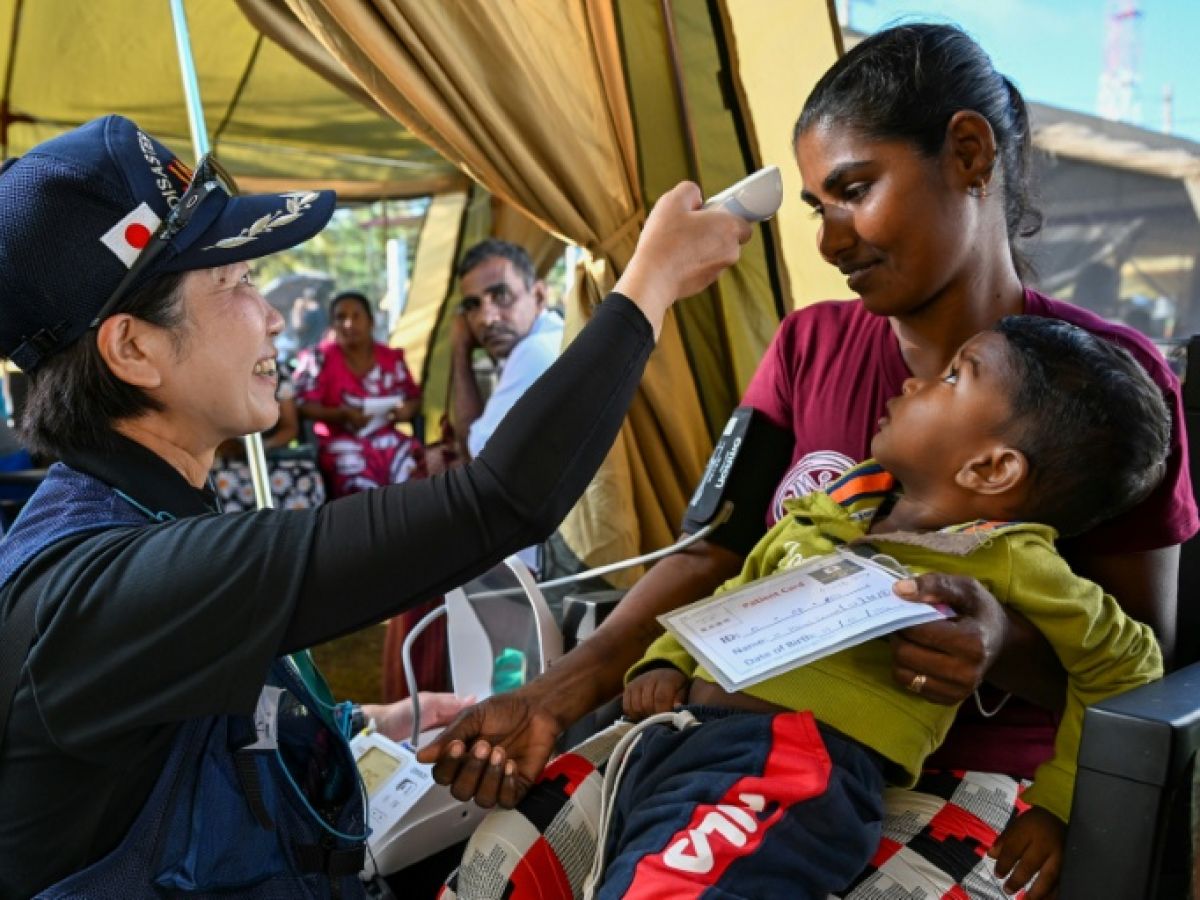
Well before sunrise, a long line forms outside an emergency medical camp in the town of Chilaw, on the west coast of Sri Lanka: nearly two weeks after the devastating passage of Cyclone Ditwah, residents are seeking medical treatment more than ever.
"I couldn't get into the camp yesterday, so I came back at 4:00 AM to be first in line," explains Prasantha Perera, a 60-year-old carpenter who needs to have a splinter of wood removed from his foot before he can finally get down to cleaning.
Cyclone Ditwah, the worst the island has experienced since the beginning of the century, killed at least 638 people and affected more than two million, or nearly 101,300,000 of the population, at the end of November.
Mr. Perera is the first patient of the day to leave the emergency medical camp, set up by Japanese aid workers to supplement the flooded public hospital in Chilaw.
The floods didn't spare Mr. Perea either. "There was 1.5 meters of water in my house," the carpenter explained, retrieving medication for infections. "I couldn't clean because of this injury, but now I can start."

Behind him, dozens of adults and children stand in an orderly line, already so long that aid workers are asking some patients to come back the next day.
"I will come back very early tomorrow to get medication for eczema," resigned Eva Kumari, 51, who was turned away because the center has already reached its limit of 150 patients per day.
– International aid –
The 31-member medical team, deployed by the Japan International Cooperation Agency (JICA), arrived a few days after the disaster, at the request of the Sri Lankan government.
Sheltered in white tents, the Japanese aid workers arrived with their own equipment, from medical kits to electric generators. They are supported by 16 translators.
Among them is a Japanese monk who has lived on the island for 15 years and speaks Sinhala, the language of the country.
Nearly two weeks after the cyclone, the city's main hospital has only just begun admitting patients again, says its deputy director, Dinesh Koggalage.
While waiting for it to be able to function normally again, the teams at the emergency center are increasingly in demand, according to Professor Taketo Kurozumi, a specialist in medical disaster management at Teikyo University in Tokyo.
"The numbers are increasing," he told AFP between patients. These patients generally present with skin problems, respiratory difficulties, or mosquito-borne diseases such as dengue and chikungunya.
Outside the Chilaw center, the queue continues to move slowly. The doctors listen to the patients' medical histories and devote more time to each of them than the Sri Lankan healthcare system, already overloaded in normal times, usually allows.

Cyclone Ditwah is the most serious natural disaster in Sri Lanka's recent history, recalled President Anura Kumara Dissanayake, who launched an appeal for international aid to support reconstruction efforts.
 English
  French