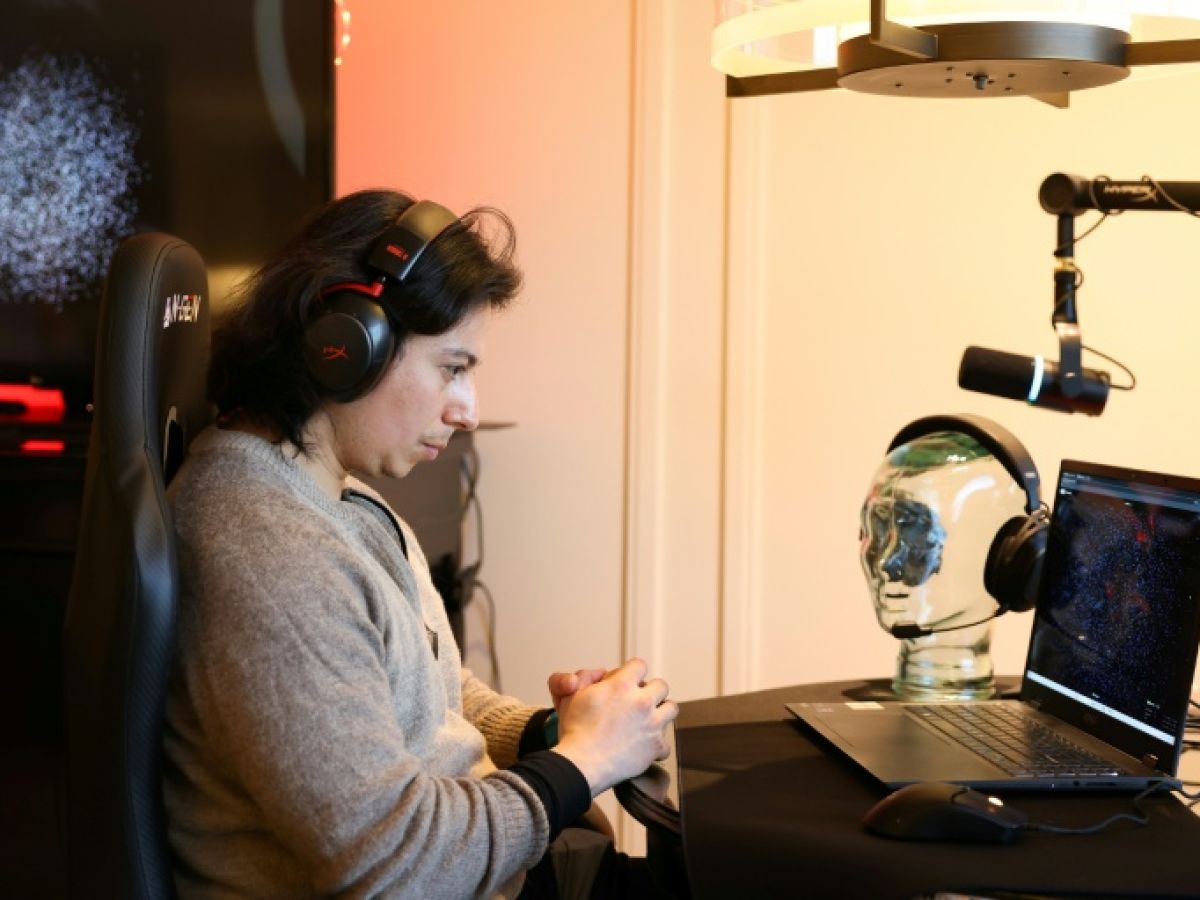
Headphones that detect early signs of Alzheimer's, an app that scans the iris for traces of cancer. Beyond smartwatches and rings, artificial intelligence (AI) aims to make self-screening for diseases widespread.
“Preventive medicine doesn’t work today because you don’t want to go to the doctor all the time for tests,” says Ramses Alcaide, head of the startup Neurable. “But what if you knew when you needed to go?”

Rings, bracelets or smartwatches, which were everywhere at the recent CES technology show in Las Vegas, can already monitor heart rate, blood pressure or glucose levels, with varying degrees of accuracy.
They respond to a strong demand from the general public, illustrated by a study published a few days ago by OpenAI, showing that more than 200 million internet users consult ChatGPT every week on health topics.
The group led by Sam Altman even launched ChatGPT Health on Wednesday, powered by a user's medical record, with their consent, and data collected by various connected object applications.
Using electroencephalogram (EEG) technology, Boston-based Neurable has developed headphones that record and decode brain activity.
The currently available model can identify brain slowdowns and suggest a break. Neurable is also working on a headset to optimize performance for gamers.
Beyond that, the start-up is developing a feature that compares data to the user's history, which will be able to detect a deviation, a possible sign of a pathology, explains Ramses Alcaide, whose company focuses on software in partnership with equipment manufacturers.
“An Apple Watch can identify Parkinson’s, but only when you start experiencing tremors,” Ramses Alcaide points out. With EEG, “you can see things before physical symptoms appear.”
This is not a diagnosis but an alert, which can also warn of depression or the onset of Alzheimer's disease, among other things.
– Detection before symptoms –
Some have reservations about the capabilities of personal EEG devices.
"I don't think they are reliable enough to detect signs" of these pathologies, says Anna Wexler, a professor at the University of Pennsylvania who studies consumer detection products, although she acknowledges that "AI has expanded the possibilities of these devices."

Neurable collaborates in particular with the Ukrainian army to assess the mental health of soldiers returning from the front, as well as prisoners of war, and to detect possible post-traumatic stress disorder (PTSD).
The young French company NAOX has developed EEG earphones connected to a small box, focused on epilepsy.
Better than seizures, which are generally "very rare", the device recognizes spikes, or "spikes", brief and abnormal electrical discharges in the brain, "much harder to see" and characteristic of an epileptic state, according to Marc Vaillaud, a physician by training and head of innovation at NAOX.
Unlike Neurable's headset, the NAOX earphones, which have received the green light from the U.S. Food and Drug Administration (FDA), are worn primarily at night, to collect several hours of data each time.
The start-up is working with the Parisian hospitals Rothschild and Lariboisière to understand the links between these "spikes" and Alzheimer's, already mentioned in publications.
NAOX also tracks sleep quality. Many connected bracelets on the market already play on this ground, "but it's not the wrist that sleeps, it's the brain," argues Marc Vaillaud, adding that their data "is only indirect."
Advances in AI and technology in general have paved the way for the miniaturization of detection devices, far removed from the heavy equipment of medical offices or hospitals, at increasingly attractive prices.
IriHealth is preparing to put on sale, for about fifty dollars, a small smartphone extension designed to take a picture of its owner's iris.
It relies on iridology, a technique generally considered scientifically unreliable. But the founders of IriHealth are convinced of its effectiveness in detecting abnormalities in the colon, and soon in the lungs or liver.
Tommy Phan, a spokesperson for IriHealth, mentions a reliability rate of 81% on patients already diagnosed with colon cancer in tests carried out by the company.
 English
  French