Brain-computer interfaces, a science fiction dream for decades, are gradually becoming a reality. These devices are supposed to connect our brain to a computer, facilitating a continuous exchange of information in both directions (from human to machine and vice versa). But for the moment, the methods used only allow unidirectional exchanges: either from brain to machine, as with... brain implants for therapeutic purposes, or conversely in extracranial devices which stimulate cognition (memory, attention, etc.). A new approach could make it possible to link these two directions, by giving implants the ability to send information to the brain. This new method, designed by researchers at Northwestern University in the United States, was presented in the journal Nature Neuroscience.
Stimulating the brain with light
To send this information to the brain, their device uses tiny lights capable of stimulating neurons that have been modified to be sensitive to this stimulation. This is achieved by injecting a virus directly into the brain, containing a gene that codes for a channel (ChrimsonR) which activates in response to light, thus enabling the neurons to be activated by these stimuli.
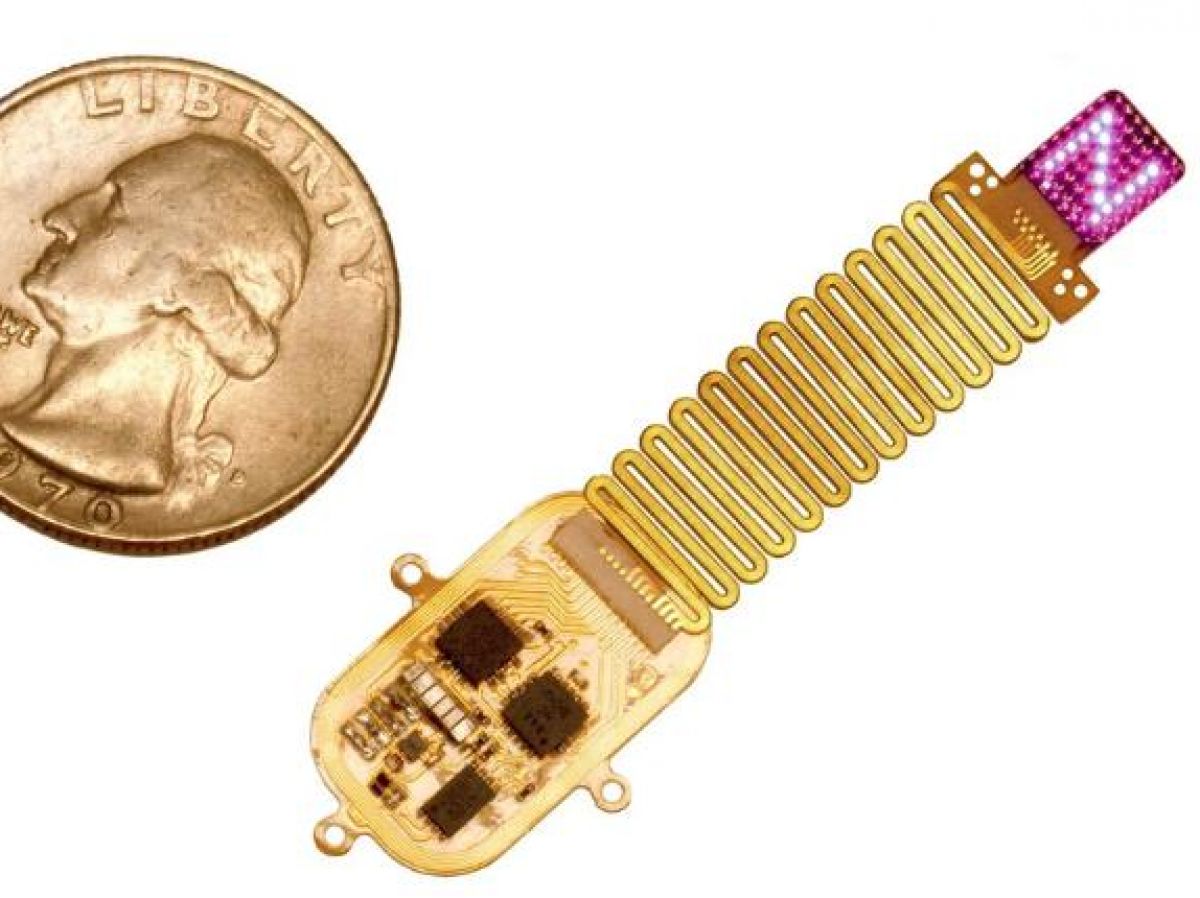
The device consists of a flexible panel of 64 μ-ILEDs, placed directly on the mice's skull, under the skin. Thanks to the small size of their heads, this panel manages to cover a large portion, allowing for the stimulation of several brain regions depending on the lights activated (something that will inevitably be more difficult to achieve in humans given the size of our brains). The panel is connected by flexible cables (so as not to restrict neck movement) to electronic components that allow the lights to be switched on or off remotely via radio frequency. We needed to think about a way to provide stimulation in an implantable, but minimally invasive format, explains in a press release John Rogers, director of the study. By integrating a flexible and comfortable panel of micro-LEDs — each the size of a human hair — with a wireless control module, we have created a system that can be programmed in real time while being completely under the skin, without any measurable effect on the animals' natural behavior.
Teaching the brain to understand these messages

Indeed, the implant did not change the animal's behavior except when it was illuminated. The researchers used it to train mice to identify this stimulation and act accordingly. The mouse had to choose between two doors: one held a reward (sugar), and the other a "punishment" (a puff of air). To guide it, the lights activated certain brain regions, and the mouse had to understand that this information meant it should go right or left.
After ten days of training, the mice injected with the optogenetic virus were able to find the sugar more easily, unlike those with the implant but without the virus (showing that what they feel is due to the stimulation of cells possessing the channel sensitive to this stimulus and not to another factor, such as the heat produced by the lights).
“ Our brain is constantly transforming electrical activity into experience, and this technology gives us a way to directly influence that process., agrees Yevgenia Kozorovitskiy, co-author of the study. This platform allows us to create entirely new signals to see how the brain learns to use them. This could be used to restore senses lost due to injury or illness, while also helping us better understand how we perceive the world. However, the path from mouse to human is still very long, but these little lights could illuminate our first steps.
 English
  French