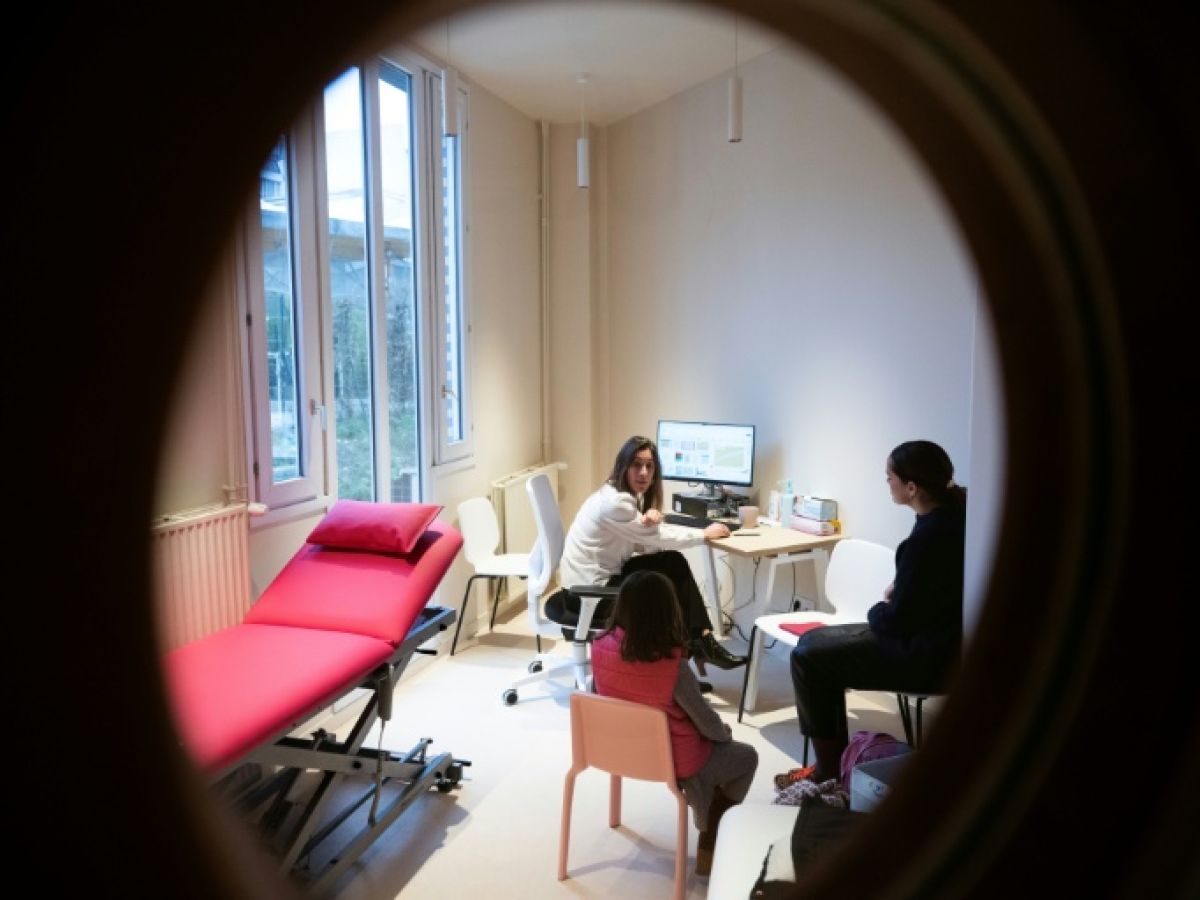
A slide to go down, a teepee to snuggle up in, stars on the ceiling… The first of its kind in France, the Asterya care center welcomes children injured and abused by their families, entrusted to Child Welfare Services in Ile-de-France, within its pastel walls.
Inaugurated on Wednesday, this Child Support Centre offers long-term, multidisciplinary day hospital care to young people – up to 25 years old – under child protection: diagnosis, care pathway, partnerships with community medicine. It is also a place for training and research.

Cream-colored walls curved like waves, a ceiling studded with LED stars, portholes at each door – one at child height, the other at adult height – a slide to go down a floor: a primary school in the east of Paris has been transformed into a luminous cocoon.
In France, out of 380,000 children entrusted to the ASE, half are "placed, that is to say removed from their family after having suffered serious violence, physical, sexual, psychological and major emotional deprivation", explains to AFP the woman who dreamed of and carried Asterya (from the Greek "aster", star) on her shoulders: Professor Céline Greco, head of the pain department at Necker-Enfants Malades Hospital.

"We also have shaken babies who present with neurological disorders," she adds.
"It is estimated that one in two children placed in the care of the child welfare services has mental health problems," she continues. "We see depression in very young children, even babies," while teenagers develop "risky behaviors and addictions."
Without early treatment, these children "risk losing 20 years of life expectancy," according to American studies.
– “Early and intensive” care –
Although they represent half of all full hospitalizations in child psychiatry, only 30% of these children benefit from a health assessment upon arrival at the ASE and less than 10% from real follow-up of their health.
However, an experimental public health program, Pegasus, "shows that early and intensive care greatly improves their health: in 24 to 36 months, they regain normal development curves," explains Céline Greco, who hopes to follow 2,000 children per year at Asterya.
Caregivers (child psychiatrists, psychologists, psychomotor therapists, speech therapists, pediatric nurses, etc.), without lab coats, welcome the child through play, "because it is still impressive to come here," Alix Bertheau, a psychologist, told AFP.
"Slide rides, a game of cards, create bonds" and make the center a safe place where "the children, and the caseworker who has been following them for years at the ASE, will feel confident," she adds.
“Spaces that we thought were playful turn out to be therapeutic. The other day, four brothers placed in different families rushed into the teepee to cuddle up to each other,” says Sylvain Turgis, director of the health division of Im’pactes, the association created by Céline Greco.
The colorful paintings of street artist Seth – little Prince with a satchel full of stars, child clutching his teddy bear… – bring poetry to the place, rented from the City of Paris by Im'pactes, co-financed by patrons (Axa, Accor, Kering…) and the AP-HP, which employs the caregivers.
"It's difficult for us to hear very difficult life stories all day, so it's important to have a nice place," says psychologist Sacha Amsellem, sitting on a child's chair in the art therapy room.
A center will soon open in Bordeaux, others should follow (Hauts-de-France, Grand-Est, PACA, Auvergne-Rhône-Alpes…).
“Failing to take care of these children is a human and financial waste: the consequences, in adulthood, of violence suffered in childhood cost society 38 billion euros per year,” notes Céline Greco.
Upon arriving in Asterya, she rejoiced, a teenage girl exclaimed: "For the first time, we have something that is truly for us!"
 English
  French