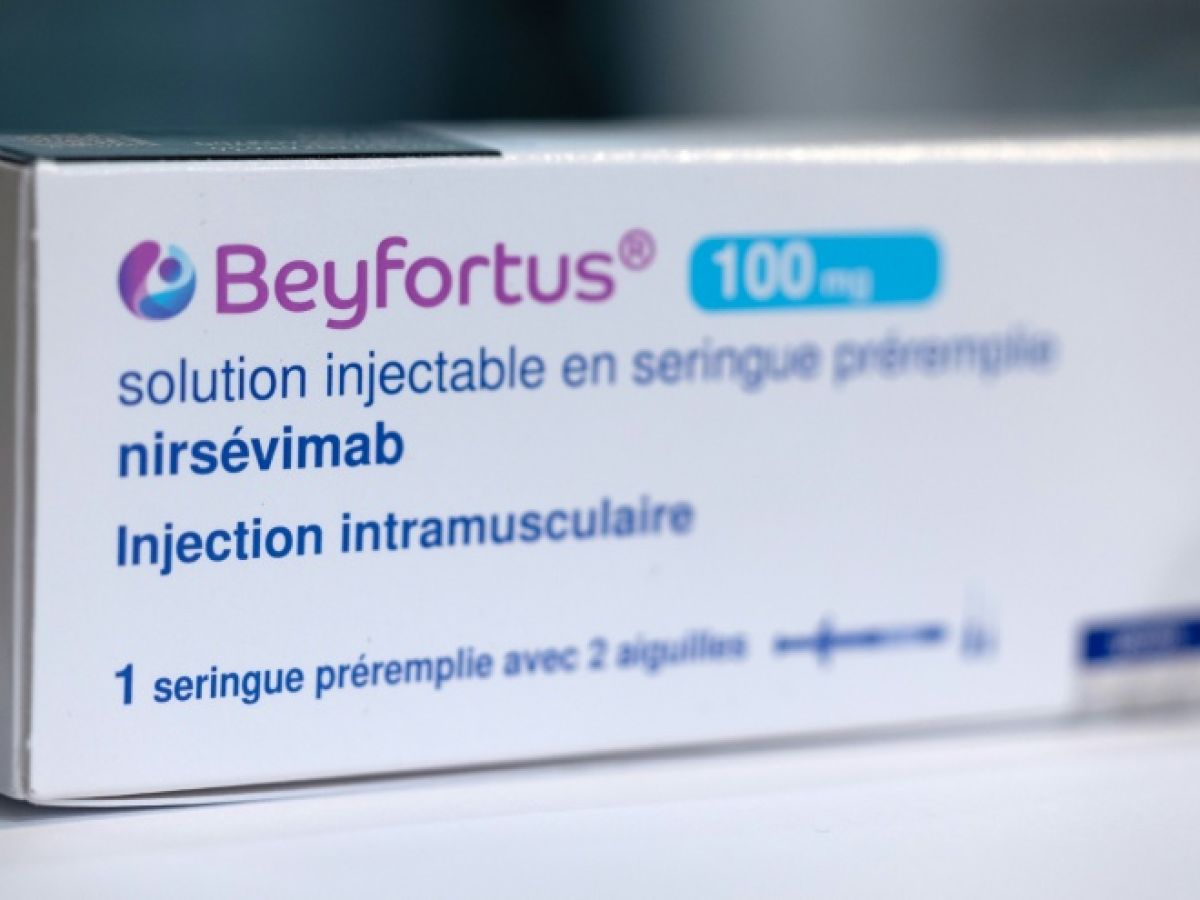
Bad news for Pfizer: its anti-bronchiolitis vaccine, Abrysvo, performs worse in babies than its main competitor, Beyfortus from AstraZeneca and Sanofi, according to a study, while many countries are hesitating over the best treatment to deploy.
Both treatments are effective. But babies immunized with Beyfortus have a 25% lower risk of being hospitalized compared to those who received Abrysvo, according to work carried out using data on tens of thousands of French infants and published in JAMA, one of the leading medical journals.

The stakes are high, both in terms of health and the economy.
Bronchiolitis affects many babies worldwide each year, most often caused by the respiratory syncytial virus (RSV). While it is generally not serious, it does require hospitalization for some.

However, effective treatments have recently emerged to protect against RSV infections, marking one of the major medical innovations of recent years. For babies, two are in direct competition: Abrysvo, from the American company Pfizer, and Beyfortus, developed by the British company AstraZeneca and the French company Sanofi.
Their objective is identical – to prevent RSV infections in very young children or to limit its extent – but their principle differs.
Abrysvo is a vaccine given towards the end of pregnancy so that the mother's immunity is passed on to the baby at birth. Beyfortus, on the other hand, is administered directly to the baby, providing it with the necessary antibodies: it is therefore not a vaccine, which leads the body to produce its own immunity.
These two treatments have already clearly demonstrated their efficacy and safety, each on its own, whether through clinical trials or real-world data. But they had never been compared.
– Beyfortus remains expensive –
Depending on the country, health authorities have made different choices. Some, like Argentina or the United Kingdom, have organized their immunization campaigns around Abrysvo, while others, like Germany and Spain, have favoured Beyfortus.
A third group did not choose. This is the case in France where, last winter as this season, Abrysvo and Beyfortus were widely offered, first in maternity wards and then, for the latter, to young babies. This gave researchers the opportunity to directly compare the two medications.
The study, conducted by the Epi-Phare group associating the French medicines agency (ANSM) and the Health Insurance, therefore concludes that Beyfortus has superior efficacy.
Not only does it do better at avoiding hospitalizations, but the difference is even more marked for the most severe outcomes, measured by the number of admissions to intensive care.
However, the researchers are careful to point out that Abrysvo already works very well and that a mother who has received it should not panic over a supposed lack of effectiveness.
"If a mother has already received the Abrysvo vaccine during her pregnancy, there is no reason to give Beyfortus to her baby: the vaccine protects him well," epidemiologist Mahmoud Zureik, who supervised the study, told AFP.
But this data could provide a strong argument for health authorities to favour Beyfortus, whose deployment, on a collective scale, would significantly reduce the number of hospitalizations.
Abrysvo, however, still has some advantages, starting with its price. At over 400 euros, Beyfortus is twice as expensive. In France, it is not fully reimbursed, a situation lamented by many pediatricians, who say that many families forgo it for this reason.
The two treatments could retain a complementary role, especially since effectiveness is not the only consideration: thus, the reluctance of some parents to multiply vaccinations in their babies for whom the first months already have a busy schedule in this respect.
“Abrysvo offers an alternative for mothers who prefer to be vaccinated rather than have their children injected,” says Mr. Zureik. He also notes that without the Pfizer vaccine, a larger number of babies would have to be given the Beyfortus vaccine, which would increase the burden on maternity wards.
 English
  French