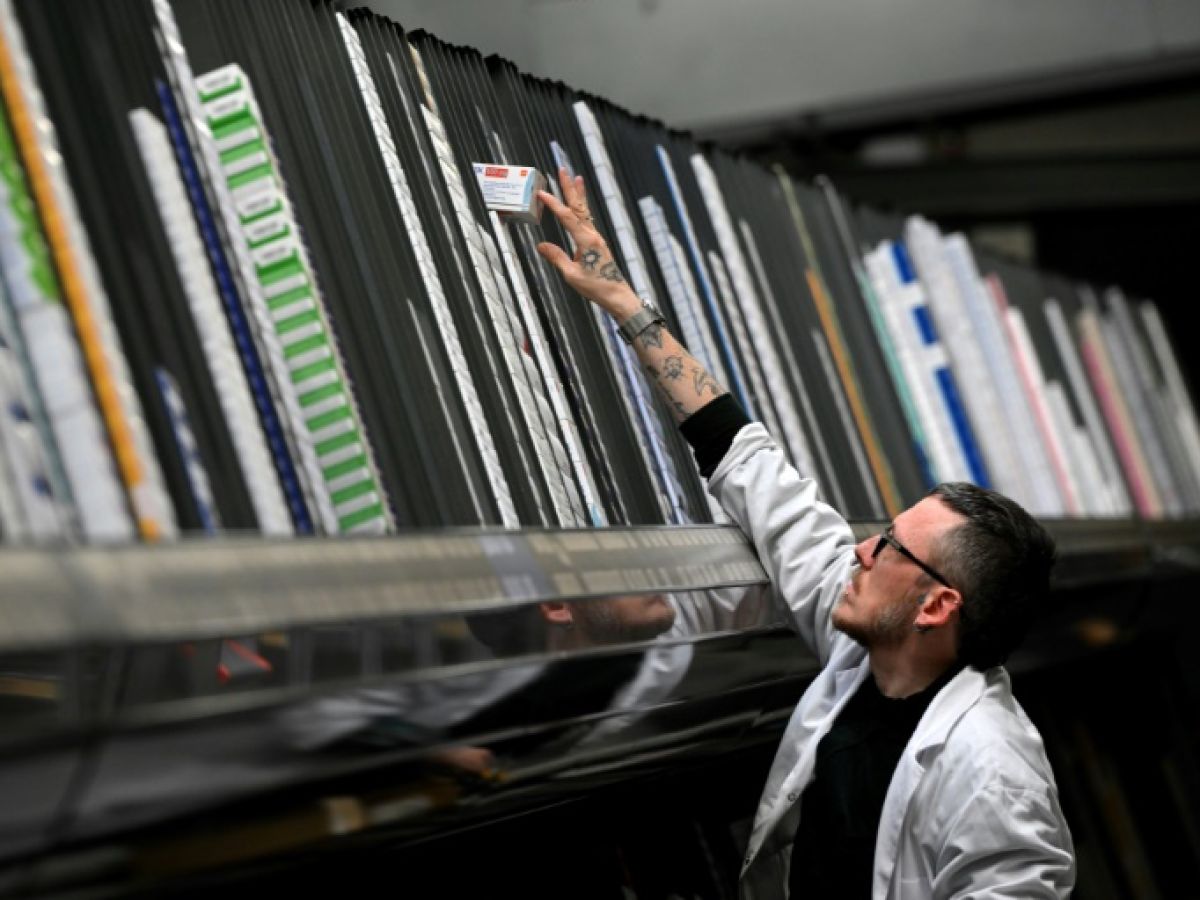
Drug shortages, which are becoming increasingly common in Europe, are particularly affecting Belgium, to the great displeasure of patients and pharmacists who deplore the EU's slowness in finding remedies for this scourge.
"It takes a lot of energy, frankly, often for an hour a day, I have to make phone calls, find out information, send the patient away, call the patient back to tell them that the medication has arrived or that they won't get their medication," Didier Ronsyn, a pharmacist in Brussels, told AFP.
"When it concerns one or two medications, it's fine, but there are often dozens that are missing at the same time, so it makes our lives more complicated," he adds.
A report published last month by the European Court of Auditors identified 136 critical medicine shortages in the EU between January 2022 and October 2024, including antibiotics and heart attack treatments.

Belgium is the most affected, with a dozen of these so-called critical shortages (for which there are no alternative medicines) notified in 2024 to the European Medicines Agency (EMA).
According to the Court, this "chronic illness" from which Europe suffers is mainly linked to problems in supply chains and the relocation of the production of many medicines and their active substances to low-cost countries.

Europe thus depends on Asian suppliers for 70% of active substances and 79% of drug precursors (biochemical substances used in their manufacture).
A particularly high dependence on painkillers as common as paracetamol, ibuprofen, certain antibiotics and salbutamol (sold in particular under the brand name Ventoline).
But this crisis is also partly attributable to internal imbalances within the EU.
– Price and packaging differences –
Drug prices vary from one member country to another because they are negotiated by national health authorities, says Olivier Delaere, head of Febelco, a distributor that supplies around 40% of pharmacies in Belgium.
Therefore, manufacturers tend to supply first to the countries that pay them the most.
And this encourages them to supply quantities calculated as precisely as possible in countries where their prices are lower, for fear that intermediaries will enrich themselves at their expense, reselling their products in countries with higher sales prices.
The Court also emphasizes that most medicines are subject to national authorizations and must have packaging that complies with the rules specific to each country.
These regulatory and packaging constraints sometimes cause "local shortages," Mr. Delaere points out: a drug may be unobtainable only in one state, while it is perfectly available in its neighboring states...

"It's a growing problem," sighs the Febelco boss, pointing out that of the million customer requests handled each year by his teams, 70% are solely related to shortages, generating "a colossal workload and a waste of energy."
– Financial incentives –
The problem is so widespread that by 2024, European pharmacists were spending an average of 11 hours a week managing shortages, three times more than a decade ago, according to calculations by the professional organization PGEU.
If pharmacists are exhausted, "it's also very hard for patients," who are anxious about not receiving their treatment on time, insists Mr. Ronsyn.
The European Union is looking for solutions, but has not yet found a panacea.
In March, the European Commission proposed a law aimed at boosting the production of critical medicines through financial incentives. In July, it also launched a "supply strategy" to coordinate stockpiles and build up crisis reserves.
A Commission spokesperson said she was confident that these measures "will have a real impact" in "helping to reduce the problem." However, they require the agreement of the European Parliament and the 27 member states, a process that could drag on.
"They're trying to find solutions, but it's still very slow," says Ronsyn, who can see the Commission's headquarters from his office. "We'll probably get there one day, but for now it's complicated."
 English
  French