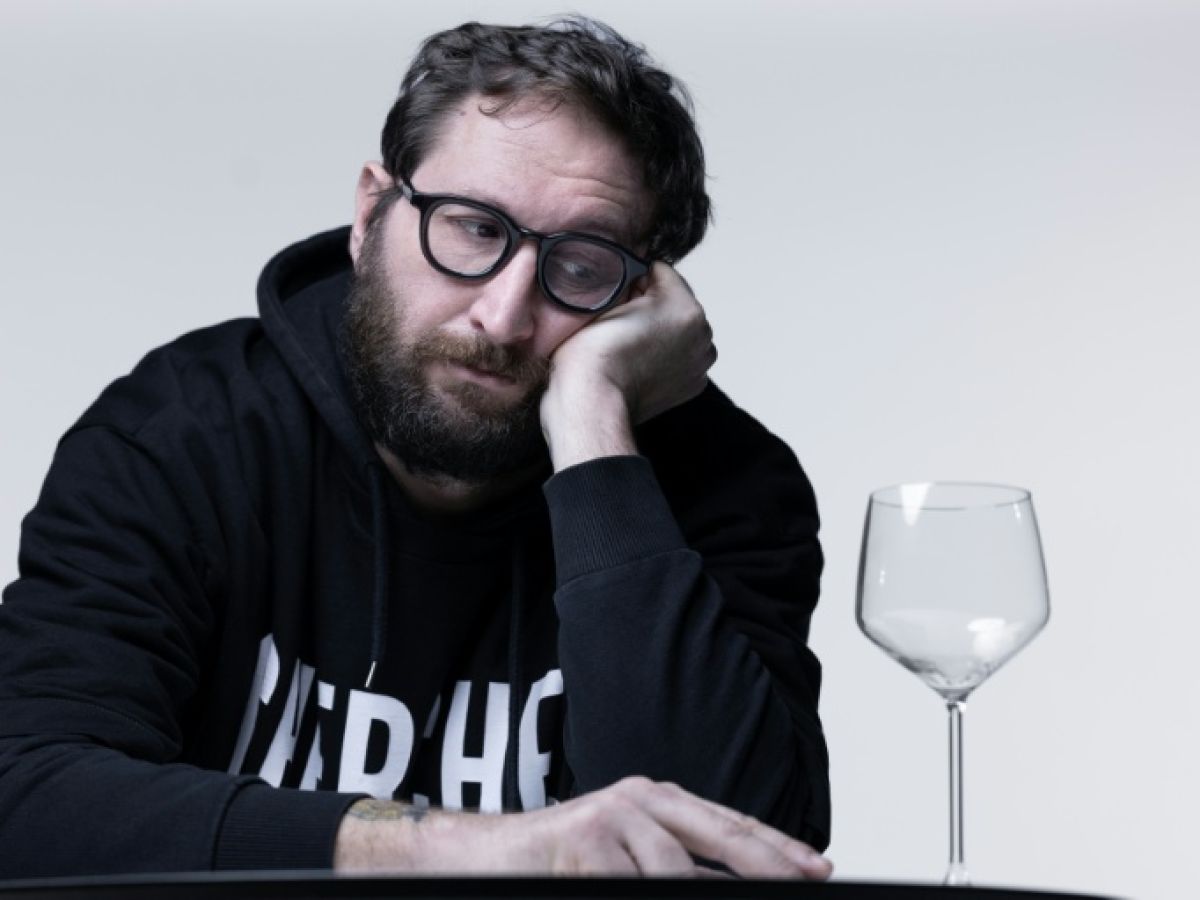
The author of the graphic novel Terreur Graphique is the latest artist to recount his alcoholism, in an album where he humorously deals with his self-destruction through drinking and then his difficult fight for sobriety.
"Addiction, please! - Confessions of an alcoholic in recovery" (Casterman) is published right in the middle of "Dry January" ("The January challenge"), which encourages people to take a break from their alcohol consumption.

"I stopped drinking alcohol in January and it's easier because other people's gaze is more relaxed. They understand," says Terreur Graphique, whose real name is Fred Lassagne, to AFP.
The 48-year-old author, based in Tours, has been sober since October 2024. "I feel very good. But I know that my condition remains fragile. I avoid bars where everyone gets wasted quite quickly," he says.

In the album, he draws himself as a dog, "to distance myself from myself," who fell into alcoholism at a young age, following in the footsteps of his father, whose office was "the bistro across the street." "Alcohol was a magic potion," he recalls.
A fan of pop culture, Terreur Graphique highlights the influence played by alcoholic or drug-addicted personalities whom he considered "cool", like David Bowie, Neil Young or Marguerite Duras, who "drank up to six liters of wine a day" before stopping.
– “Alcohol is everywhere” –
"Recently, sobriety is no longer seen as boring or marginal, but as a political choice, a mental health strategy, or even a regaining of control over oneself," writes Camille Emmanuelle, in "Alcohol, do we have a problem?" (La Martinière), a small book intended for young people.

The author, who is a journalist and screenwriter, says she became sober five years ago after realizing, following years of denial, that she had "a real problem with alcohol".
“In France, alcohol is everywhere and the solicitations are constant,” but “by refusing a drink, you instantly disappoint the person in front of you. You come across as a killjoy,” testified former journalist Charlotte Peyronnet in “Et toi, pourquoi tu bois?” (Denoël), published in 2024.
Among the artists who have spoken about their alcoholism is the actress Muriel Robin, who acknowledged in the documentary "Alcohol in Women: They Break the Taboo" (broadcast by France 5 in 2025) that alcohol had been "a real crutch" when she was "in great suffering." But "it comes at a high price," she added.
In an essay released in early January, "Les assoiffés" (Grasset), psychiatrist Camille Charvet testifies to the diversity of patients, including many alcoholics, whom she welcomes to the addiction center where she works in Paris.
"Addiction appeared to me not only as a disorder, but also as a mirror. A mirror of our time, of its injunctions, its denials, its collective flaws. It is, perhaps, its most sincere symptom," she summarizes.
Beyond the personal sphere, alcohol has also played a notable role in history, says physician and historian Michel Craplet in "Power and Intoxication" (Odile Jacob), published in early January.
"Many events that occurred during revolutions and wars were determined by the drunkenness of combatants," says the author, who also looks at "the known or hidden drunkenness" of historical figures, citing "Yeltsin, Churchill, Cambronne, Louis XVI, Attila or Alexander the Great."
Donald Trump's chief of staff surprised many in December by telling Vanity Fair that the American president had the "personality of an alcoholic," in the sense that he "acts with the idea that there is nothing he cannot do. Nothing, zero, nothing."
The American president responded by pointing out that he did not drink alcohol at all, and added: "I have often said that if I did, I would have a very high chance of being an alcoholic."
 English
  French