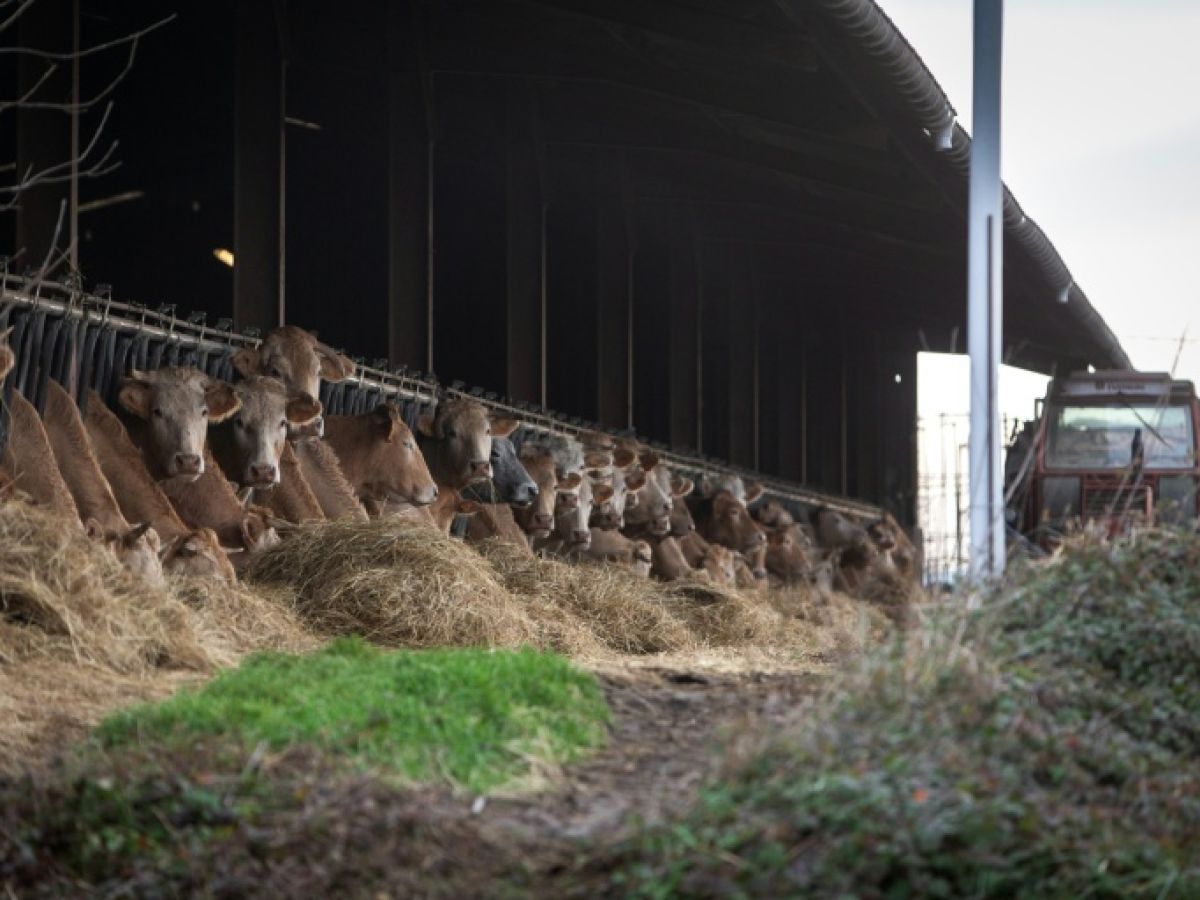
Contagious nodular dermatosis (CND), a disease affecting cattle and which appeared in France in June, threatens an already strained herd: the fight against this scourge has led to radical sanitary measures that are increasingly contested on the ground.
As of December 11, 110 outbreaks had been detected in France, in the departments of Savoie, Haute-Savoie, Ain, Rhône, Jura, Pyrénées-Orientales, Doubs, Ariège, and Hautes-Pyrénées. These outbreaks affected 75 farms, according to the Ministry of Agriculture. Just over 3,000 cattle had been euthanized (out of a total herd of approximately 15 million head).

What is DNC?
DNC, detected on June 29 in a farm in Entrelacs, Savoie, is a viral disease which leads to "significant production losses" which can lead "to the death of part of the infected herd" (approximately 10%), according to the ministry.

It causes, among other things, fever, decreased milk production, enlarged lymph nodes, and nodules on the skin and mucous membranes of animals.
The ministry specifies that DNC is "not transmissible to humans" and there is "no risk to human health linked to the consumption of products from these animals."
An emerging disease transmitted by insect bites (biting flies or horseflies), it is present in sub-Saharan Africa, Asia, and since 2023 in North Africa. In Europe, it was detected on June 22 in Sardinia, after having previously been prevalent in the Balkans in the late 2010s, particularly in Greece.
How to fight it?
France adopted a strategy in July which includes:
– the “total depopulation of cattle from infected areas” to extinguish the sources of the virus, “in accordance with European obligations”, which may lead to the slaughter of an entire batch of animals on a site.
– the establishment of “regulated zones” within a 50 km radius of the outbreaks, including restrictions on livestock movement. In these zones, vaccination is mandatory for all cattle, regardless of age, and is covered by the state. To date, one million animals have been vaccinated, according to Minister Annie Genevard.
– These regulated areas switch to “vaccination zones” if at least 75% of the cattle herd has been vaccinated there for more than 28 days and if the last outbreak has been depopulated for at least 45 days.
The resumption of live cattle exports is only possible with the agreement of the destination country. Currently, in Europe, two countries have agreed to receive, under certain conditions, cattle from a vaccination zone: Italy – the leading buyer of young French calves – and Switzerland.
What support is there for farmers?
The state compensates "owners of euthanized animals" and takes charge of "cleaning and disinfection operations" as well as "the disposal of the carcasses of slaughtered animals", according to a decree from July.
On Friday, the minister assured that "not a single euro cent will be lost for farmers."
This strategy has been validated by the FNSEA-Young Farmers alliance, the leading agricultural trade union force.
The FNSEA fears widespread vaccination due to a "risk of collapse in exports and prices", explained its president, Arnaud Rousseau.
"We may be forced to do so if the disease becomes uncontrollable. But vaccinating 15 million animals takes between 30 and 40 weeks" before achieving national coverage and hoping to "return to disease-free status," he stressed.
Resistance
The Confédération paysanne, the 3rd largest union, affirmed its "opposition to the total slaughter of herds from the first positive analysis of the DNC", judging that asymptomatic animals must be given a chance to develop "an immune response".
Several of its members, as well as farmers from the Rural Coordination (2nd union), have taken turns over the last two weeks in farms in Doubs, Ariège, to block the slaughter.
This epizootic is a major blow to livestock farming in France, after a 2024 marked by the resurgence of epizootic hemorrhagic disease (EHD) and bluetongue (BT).
The country has the largest cattle herd in the EU, but this has declined faster than sheep and goats in recent years due to a lack of manpower and income.
 English
  French