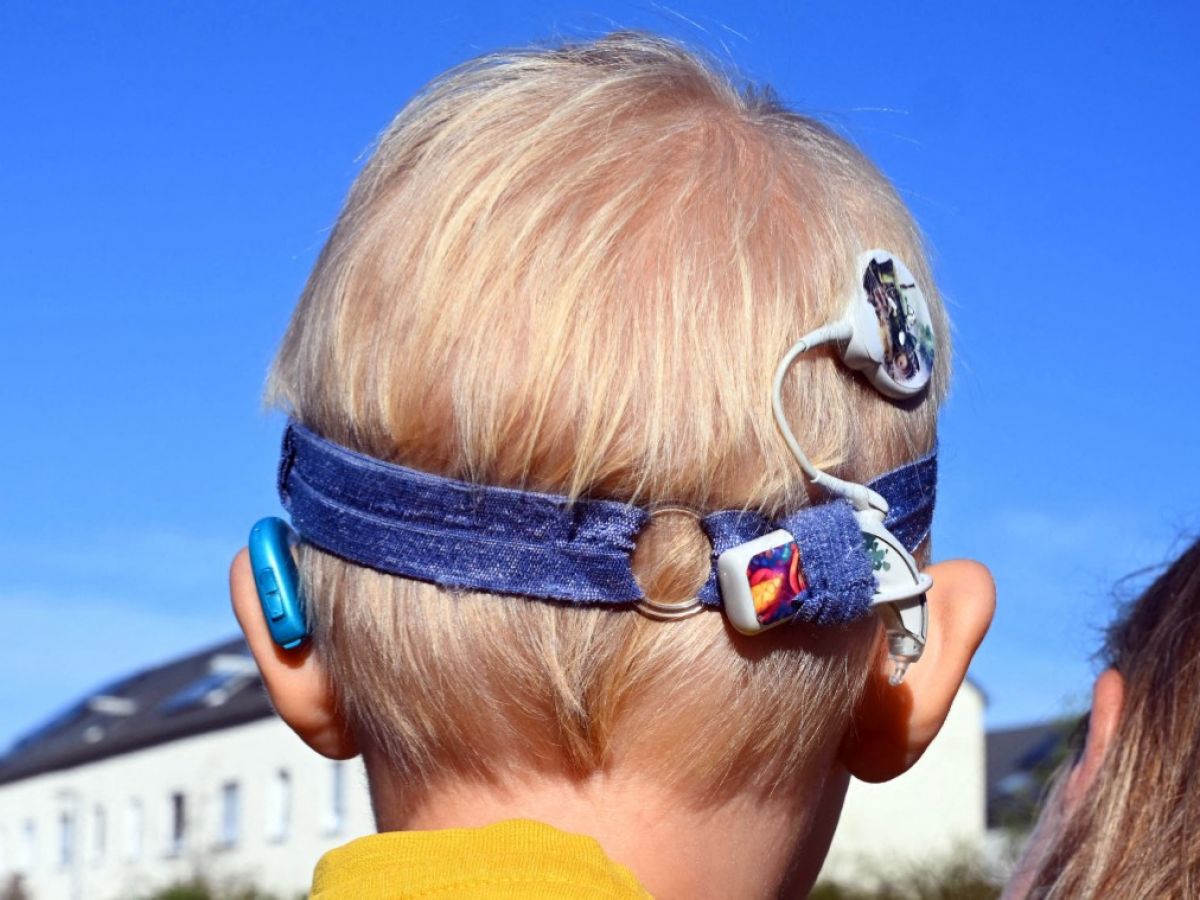
Sciences and Future: As someone who was born deaf and has a cochlear implant, you question the benefit of this device, which removes the individual from the world of the deaf community but doesn't necessarily make them fully accepted by the hearing world. Instead of placing an individual between these two worlds, wouldn't it be better, you ask, to fully facilitate their integration into just one—the world of the deaf?
Anthony Valla: I will try to be as clear as possible on this complex and sensitive issue in the deaf community.
With the Hippocratic Oath, medicine has the will to heal and repair. But it is often through ignorance or the influence of a third party that things go wrong. Let me explain:It often starts with a pregnant woman. The doctor raises the issue of newborn screening. It's mandatory, but the doctor must obtain parental consent. Forty-eight hours after the baby's birth, the first screening test is performed. For the parents, on top of the exhaustion and stress of childbirth, there's added anxiety and worry. Moreover, since the technique isn't 100% reliable, it can provide inconclusive results that may raise questions and concerns. And, like any measurement technique, screening can also produce false positives. What will we do in that case? Implant a hearing child? That would be a waste.
Next comes the second point: who decides whether to implant the child? The child himself? He won't be able to decide. Especially if it's a 48-hour-old baby… My opinion is to let him choose when he has all the necessary abilities to make the decision. But I completely understand that in the meantime, he'll miss the opportunity for auditory learning. Indeed, the brain begins to perceive sounds as soon as the baby is in the womb. Thanks to brain plasticity, the earlier, the better.
Distraught parents in the face of disability

That is why, in the situation where the baby's deafness is diagnosed, it is natural that we turn to the parents who find themselves totally distraught by the fact that they have learned that not only is their child deaf, and therefore not perfect, but are also bombarded with a lot of information: why he is deaf, the measures to take, etc.
What should be the doctor's position in this situation?
It is precisely at this point that their role is crucial. They must provide the parents with as much information as possible. This involves taking the time to meet with them, and even seeing them several times if necessary. They must lay all the cards on the table: hearing aids, cochlear implants, sign language… Unfortunately, this last option is often overlooked. This is either due to a lack of awareness, fear (because it's a long-term commitment and life-changing), or the influence of cochlear implant companies that promote the device as a miracle cure, like any good pharmaceutical lobby. However, it is important to emphasize that implantation is not a miracle cure. It depends on the individual's wishes and those of their family and friends.
Read alsoDark matter and dark energy "for dummies": at Utopiales, an interview to understand the essentials
The child may reject the implant.
This is why deaf people are demanding that the option of French Sign Language (LSF) be presented on an equal footing with other solutions. The slogan for the 2025 International Day of the Deaf (IDD) is: "No human rights without rights in sign language."
Sometimes, the doctor doesn't dwell enough on the "rehabilitation" phase that follows implantation. More complex and lengthy than the surgical procedure itself, it involves numerous adjustment sessions and speech therapy to help the child adapt to a world of sound that will never be entirely identical to that of hearing people and will always remain distorted and incomplete. Nor does the doctor dwell on the potential risks, not at the surgical level, but afterward. For example, the child might reject the implant, or turn against their parents. The occurrence of identity disorders, behavioral problems, and even physical issues such as fatigue and tinnitus have also been reported.
A very concrete example: a mother who is a psychomotor therapist had a deaf child. He received a cochlear implant at ten months old. Now, he is six years old. The first thing he does when he gets home from school is remove the cochlear implant to regain his deafness and, presumably, to "turn off" the sounds of everyday noises. His mother feels helpless because the child's deaf identity remains despite the cochlear implant. She has had to resign herself to learning French Sign Language (LSF) to be able to communicate with him.
A community in decline
In my own case, back in the 1990s, I was fortunate to have a medical team that rejected cases indicating that hearing aids might be sufficient. They gave my family the contact information of everyone who had received implants so they could gather feedback and experiences.
Is the deaf community afraid of disappearing?
Logically, a cochlear implant transforms a deaf person into a hearing person, but deep down, that person will always retain a need for and a search for a deaf identity. As a result, some implanted individuals are leaving the deaf community, leading to fears of its gradual disappearance. We are currently observing this phenomenon, slowly and irreversibly. Personally, at first I considered it a far-fetched idea, but over time I've come to realize that it's real and tangible.
There was a significant event in this journey: in 2016, the National Institute for Young Deaf People (INJS) in Cognin, Savoie, invited Benoit Virole to give a lecture on the future of deafness. A doctor of psychopathology and linguistics, he had written Psychology of DeafnessHe clearly summed up these fears in one sentence: "Yes, the community will disappear. Not in the distant future, but in the current century; it's very close." This caused a huge shock among the deaf public.
Read alsoChildhood deafness: a new gene therapy could restore hearing with a single injection
Deafness, rarely present in fiction
But I have high hopes. Because some people with cochlear implants want to reclaim their deaf identity. Take my case, for example. I was implanted against my will at the age of 7. And it wasn't until I was 23 that I discovered French Sign Language (LSF). I'm now very involved with the STIM Sourd France association, which I represent, to develop LSF vocabulary. There are clearly situations where a person finds inner peace after discovering and learning LSF.
In works of fiction, disabled characters often compensate with extraordinary abilities. In Marvel, Daredevil gained a radar sense after losing his sight. Professor X of the X-Men is paraplegic and telepathic. Zatoichi is blind but an extraordinary swordsman. The blindness of Vittorio Gassman's character in Women's Perfume It gave him a very keen sense of smell. However, deafness is very rarely represented. Why do you think that is?
After several discussions with deaf people who are passionate about culture, we came to an idea: Western culture is heavily influenced by Greek philosophy and mythology, and we find several references related to blindness within it.
A sign language that is sometimes forbidden
What about deafness? We can assume that it is unfortunately due to the philosopher Aristotle, a disciple of Plato, who held a categorical opinion: without speech, there is no thought; it is language that creates reasoning. According to him, "People born deaf are all mute. They emit sounds but have no language." and for deafness acquired after birth, "It is evident that if any one of the senses has disappeared, it is necessary that a certain type of knowledge has disappeared with it, a knowledge that is therefore impossible to acquire.". So, based on this principle, Greek mythology has very few references to deafness.
This heavily influenced the Milan congress of 1880, which resulted in recommendations favoring oral communication over sign language. Subsequently, the administrations of various institutions serving deaf people issued more or less strict bans on the use of French Sign Language (LSF).
Then, the deaf community fought hard in the 1970s and 80s, inspired by other struggles such as feminism and the fight against racism. This period is known as the "Deaf Awakening" and its main objective was the rehabilitation of French Sign Language (LSF) and the rights of deaf people.
Voices have been freed, and some deaf people have been able to write works that are mostly autobiographies, documentaries about deaf history and identity. Thanks to these works, deaf people are becoming increasingly visible in society. But this is all very recent.
A stab in the perfect child
By wanting humanity to be perfect, aren't we tending towards a society that would be less tolerant of differences, less rich, since, as you say elsewhere, one of the characteristics of the deaf community is precisely to be very open to others because it knows all too well the burden of difference?
Indeed, from birth, a deaf person—whether implanted or not—is already confronted with difference simply through newborn screening. The dream of the perfect child imagined by the parents takes a serious hit.
This can then lead to a form of "rejection" from the parents towards the child. That's why I want to do newborn screening as late as possible, at least after the relationship between the child and their parents has been established.
Tolerance as a cardinal value
A deaf person, like a disabled person, is therefore well placed to talk about difference. If they meet another person with a disability or who is different in terms of gender (feminism, LGBTQ+) or diet (gluten, vegan, vegetarian…), they will be much more tolerant of their difference, will ask them questions, and without filters, a characteristic often common among deaf people.
Furthermore, the struggle waged by the deaf community has points in common with other movements (feminism, LGBTQ+) such as self-recognition, rights, accessibility, etc.
You are an advocate for a wider dissemination of sign language. Why?
First, let's dispel a common misconception about sign language, which is too often seen as a universal language. It isn't. There's French Sign Language, which I use. There's German Sign Language, English Sign Language, and so on, because it's specific to the culture of the deaf person. This language also evolves regionally, just like accents do for hearing people. It also evolves over time, incorporating new words and technologies. For example, deaf people of my generation used to sign the television by rotating both hands to each side to imitate the button settings. But today, young deaf people sign the television as a large flat screen…
A still insufficient vocabulary
However, French Sign Language (LSF) suffers from a major shortcoming: its vocabulary is limited. In fact, it was only in 2005 that it was officially recognized by the French state as a language. It is urgent to catch up. I'll give a striking example: we cannot sign the names of insects distinctly, like "bee," "wasp," "hornet," "bumblebee." For each of these species, we are forced to sign the words "insect," "flying," "sting," and then have to figure out how to make the other person understand which insect species we are talking about.
Recently, the global deaf community has been working on establishing an international sign language. It should be as neutral as possible so that it can be easily understood by someone from Chile as by someone from China. For example, in France, the month of April is signed with the fish symbol associated with April Fools' Day. I don't know if other deaf people around the world will understand this sign… That's why we sign with four outstretched fingers so that it refers to the fourth month of the year. So, something neutral and understandable. There are no political, national, or gender references in a sign language to avoid any form of discrimination. Unlike in the French language with le/la/lui/elle.
LSF for babies, autistic people and concerts
More generally, sign language is a true asset to society. From sign language emerged baby sign language, or more formally, "gestural communication associated with speech," to facilitate communication between child and parent before the child develops oral language skills. It allows the baby to establish communication methodologies and generates less frustration because they can express their needs.
Sign language also allows some autistic people to express themselves in ways other than speech, as the AutiSignes association does for example.
In short, sign language is a way for every human being to express thoughts and emotions. It can also be a form of catharsis. Recently, there has been an increasing number of "signed songs" at concerts, an artistic expression consisting of expressing the lyrics of a song in sign language to the rhythm of the music, thus combining words with gestures and amplifying the intended emotion.
Furthermore, every disability presents an opportunity for society to perceive difference and learn to live with it, rather than hiding and discriminating against it.
 English
  French