At 32, Carine was expecting a child when she learned she had breast cancer. To better understand these tumors, which are increasingly common in young women, and to find their weaknesses, researchers in Nantes are studying them cell by cell to develop new treatments.
It all started with a lump in her breast. A doctor reassured her:« No problem, nothing serious, you're young«"But six months later, the diagnosis came, while she was pregnant.".

“ I had to have an abortion.«" says the woman in her thirties, who is now involved in the Jeune & Rose association.
In France, more than 3,000 women under the age of 40 are diagnosed with breast cancer each year. Twenty years ago, this figure was around 2,000. In this age group, the disease is often more aggressive, although researchers do not yet fully understand the reasons why.

This is the objective of the Artemis project, led for the past few months by Vincent Guen, a biologist at Inserm, at the Nantes-Angers Cancer and Integrated Immunology Research Center. Funded to the tune of 250,000 euros by the Pink Ribbon association, it is scheduled to run for at least five years.

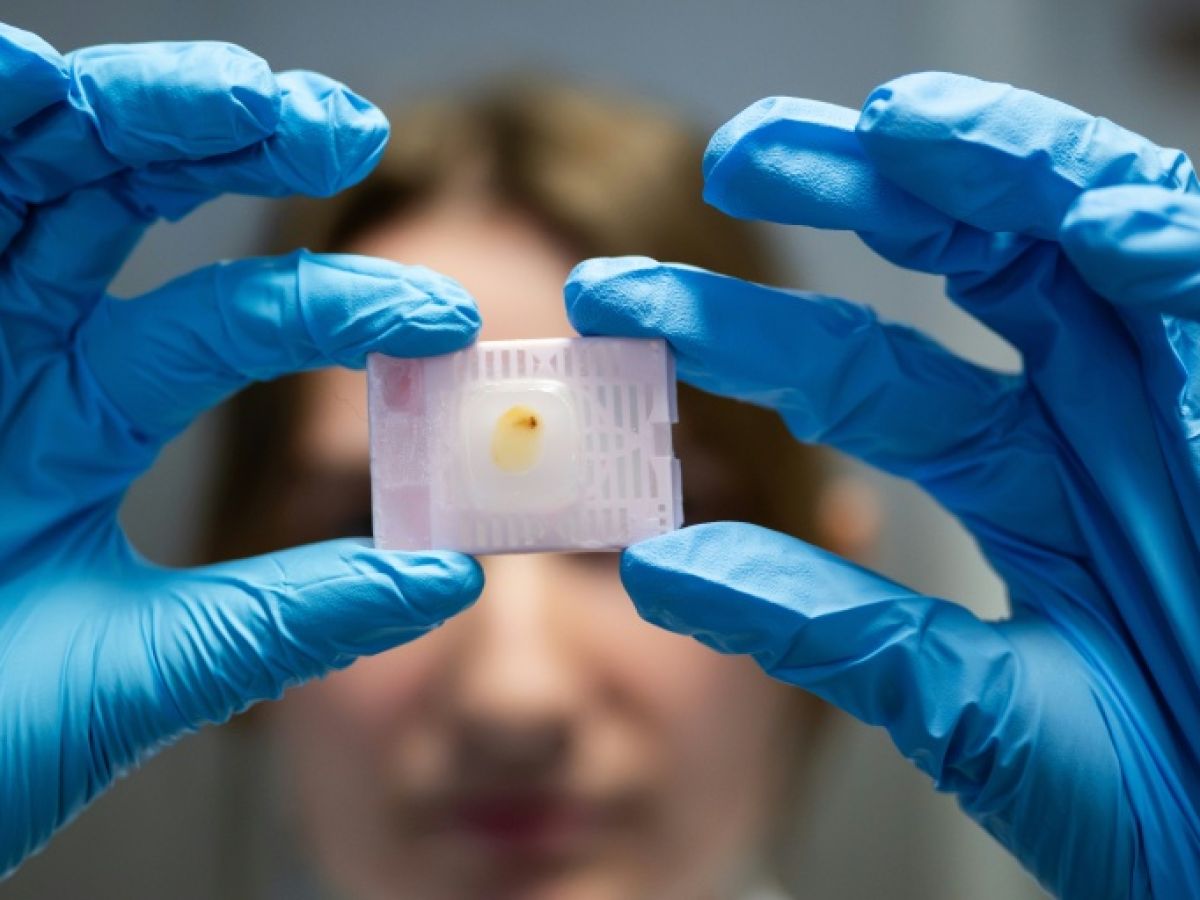
A researcher observes a tumor sample on October 8, 2026 in Nantes (Credit: AFP – Sebastien Salom-Gomis)
“ It is thought that in breast cancer in young women, cancer cells have greater plasticity«" explains Vincent Guen. In other words, they could more easily change their behavior, better adapt to their environment and become more aggressive.
“ By changing their identity, some cancer cells can at one point adapt to resist anti-cancer treatments, then, once these treatments are lifted, resume proliferating."r," the biologist elaborates.
His hope: to unlock the molecular and cellular mechanisms responsible for this plasticity in order to prevent cancer cells from evading treatments.

Vincent Guen, a biologist at Inserm, poses on October 8, 2026 in Nantes (Credit: AFP – Sebastien Salom-Gomis)
Read also Early cancers: investigation into a mysterious increase
Eto establish the identity card of tumor cells
Around him, a team of about ten people (researchers, engineers, clinicians) is working on 80 tumor samples taken from young women and made available by the Western Cancer Institute (ICO).
These initial samples concern so-called hormone-dependent cancers, whose growth is stimulated by female hormones (estrogen, progesterone), the most common type. Researchers then hope to study so-called "« triple negative«", more difficult to treat.
The first step is to establish the identity card of the tumor cells.
In the laboratory, Chloé Grivaud, a doctoral student in bioinformatics, presents a fragment of tumor preserved in a block of wax on a slide a few centimeters long.
This is then analyzed by a state-of-the-art space biology device, capable of simultaneously detecting, through fluorescence, dozens of proteins likely to reveal the aggressiveness of cancer cells.
“ We will look, for example, at whether the cells that express a certain marker of aggressiveness are always in contact with certain immune cells.«" explains Éloïse Grasset, co-leader of the team.

A researcher studies organoids, tiny tumor models grown from patient samples, on October 8, 2026 in Nantes (Credit: AFP – Sebastien Salom-Gomis)
Read also Cancer and fake news: the president of the INCa separates fact from fiction
Identifying the vulnerabilities of these cells that survive the treatments
To test these hypotheses, the CNRS researcher reproduces in vitro tiny three-dimensional tumor models, called "« organoids«" , from samples taken from patients.
In the time-lapse video of an experiment, cancer cells leave an organoid. Some migrate in groups, others detach and move forward alone.
These models allow us to study the aggressiveness of tumor cells and to identify the proteins that promote their movement, in the hope of discovering new therapeutic targets.
The whole point of Artemis is to find the vulnerabilities of these cells that survive the treatments.
In her laboratory, doctoral student Camille Tessier is testing molecules on organoids that could eliminate them or make them sensitive to therapies again.
In front of a microscope attached to a robotic arm, engineer Steven Nedellec demonstrates how cells are automatically photographed every six hours without disturbing their environment. Nuclei appear blue. Dying cells turn red.

A researcher prepares tumor samples on October 8, 2026 in Nantes. (Credit: AFP – Sebastien Salom-Gomis)
By monitoring the progression of this color, researchers can measure the effectiveness of the molecules and the speed of their action. The device allows for the testing of thousands of molecules.
“ We are in the early stages«,” warns Camille Tessier. “A promising molecule in the laboratory is still far from becoming a drug.”.
“ You can tell that research is really not far behind in improving treatments«,” says Carine, who is not part of the Artemis cohort. After surgery and radiotherapy, the thirty-something has just suspended her hormone treatment. She should be able to realize her dream of having a child next year.
 English
 French