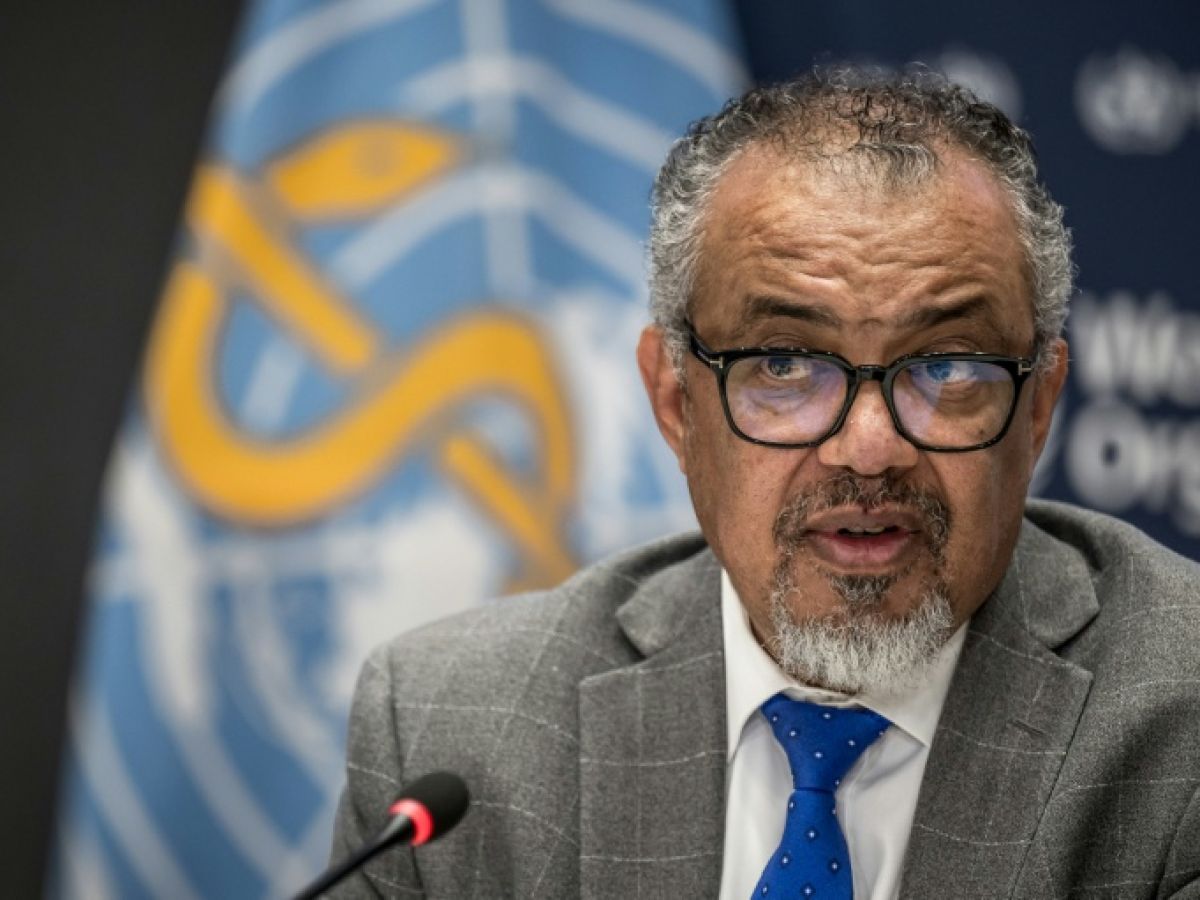
The World Health Organization (WHO) went through one of the most difficult periods in its history last year with the announcement of the withdrawal of its main contributor, the United States, an opportunity to refocus on its priorities, its director-general said on Monday.
Just hours after returning to the White House in January 2025, US President Donald Trump announced drastic cuts to US foreign aid and signed an executive order for the United States to withdraw from the WHO after a mandatory one-year period.
Several other countries have also reduced their support for international aid.
The past year "has undeniably been one of the most challenging in the organization's history," said its director-general, Tedros Adhanom Ghebreyesus, at the opening of a meeting of the WHO Executive Board at its headquarters in Geneva, Switzerland.

"Significant cuts in our funding have left us no choice but to reduce the size of our workforce," he said.
Last week, he stated that the WHO had "managed to reduce (...) to 1,241" the number of layoffs, while "1,162 staff members have left the organization or will leave through retirement, early voluntary retirement or natural retirement".
"Over the past 12 months, we have gone through a painful but necessary process of setting priorities and realigning," he said.
The WHO chief stated on Monday that he considered this process "largely complete": "We have reached stability and we are moving forward."
"We have certainly faced a major crisis over the past year, but we have also viewed it as an opportunity," he insisted, judging that "this is a chance to achieve a leaner WHO that will focus more on its mission."
– American withdrawal –
He called on countries to continue to gradually increase their contributions to reduce the WHO's dependence on voluntary contributions.
In May 2025, member states approved a second increase of 20% in mandatory contributions. But this is not enough, as the WHO remains largely funded by voluntary contributions from states.
Three increases are planned for approval in May 2027, May 2029, and May 2031, according to the WHO chief. The ultimate goal is to raise them to 50% of the core budget, compared to 14% in 2022.
The goal, he stressed, is "not to depend on a limited number of donors" and "not to depend on rigid and unpredictable funding."
The Executive Council is due to review the withdrawal notifications from the United States and Argentina this week.
But "this (American) withdrawal notification raises questions," according to the WHO.
The United States is indeed supposed to be up-to-date with its payments to the organization if it wants to leave it. However, it owes it approximately $260 million (€220 million).
Meanwhile, the American flag outside the WHO headquarters has been removed, with the US mission in Geneva stating last week on X that the flag was "dedicated to American lives lost" during the Covid-19 pandemic.
The US withdrawal should prompt countries to discuss the "future and purpose" of the WHO, Israel told the Executive Council on Monday.
Global health has reached "a critical turning point" as conflicts, humanitarian crises and climate change exert "unprecedented pressure on health systems," Bulgaria noted on behalf of the EU.
 English
  French