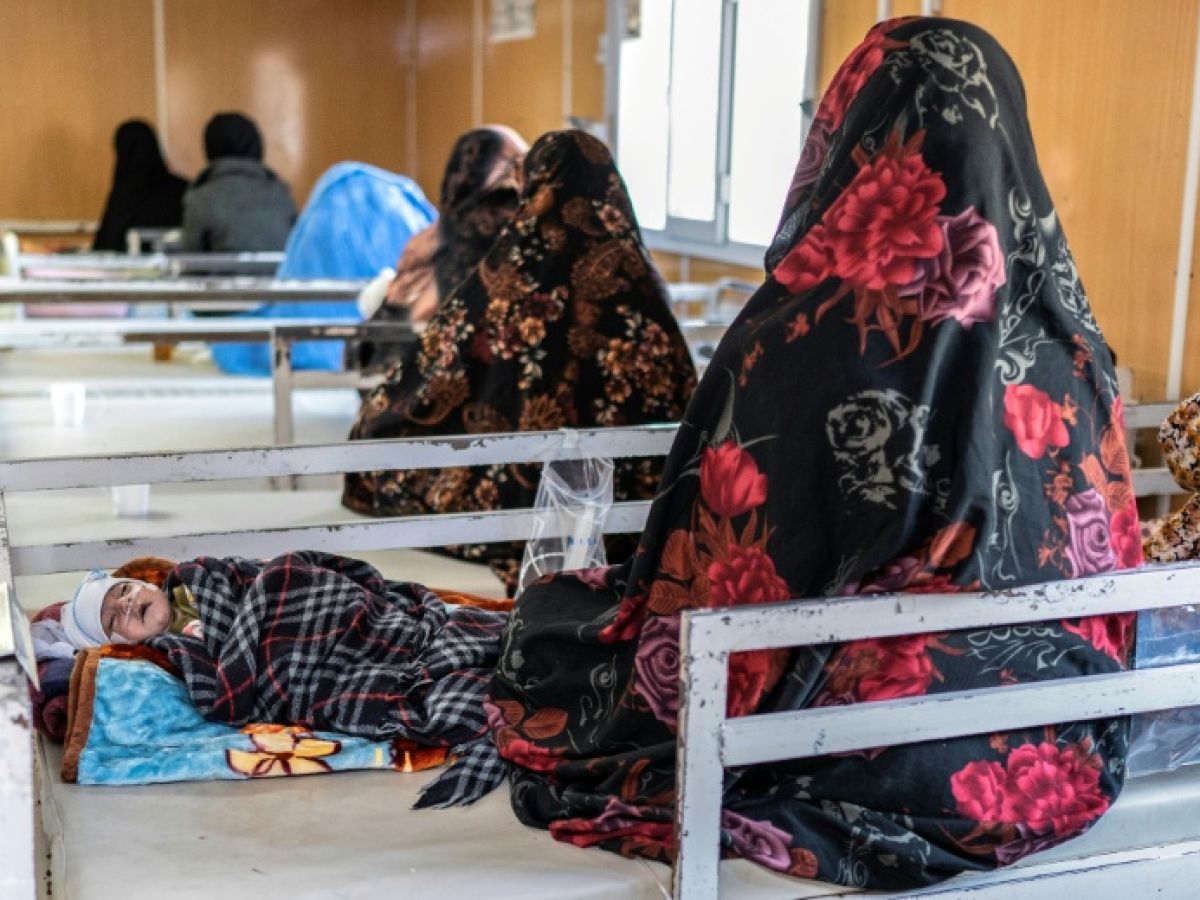
"No one can imagine what I'm going through": in an intensive care unit, 24-year-old Najiba tirelessly watches over her baby, Artiya, one of some four million children at risk of dying from malnutrition this year in Afghanistan.
The young woman with large dark eyes, who prefers not to give her last name, arrived several weeks ago at the pediatric unit of the regional hospital in Herat, a large city in western Afghanistan. She and her husband had almost lost hope.
The caregivers from the NGO Doctors Without Borders (MSF) who support the public hospital took her in urgently, along with Artiya, to their therapeutic nutrition center.

On the walls, colorful drawings of balloons and flowers attempt to bring a little cheer to the dozens of bedridden children. The mothers, facing the unspeakable ordeal of no longer being able to adequately feed their children, receive psychological support.
"By 2025, we had already recorded the highest increase in child malnutrition" in Afghanistan since the beginning of the 21st century, the director of the World Food Programme (WFP) in that country, John Aylieff, told AFP.
The increase will continue in 2026, he adds, "nearly four million children will need treatment for malnutrition, it's staggering!" "These children will die if they are not treated."
– “Not enough milk” –
In 2021, the last American armed forces left the country in a hurry under pressure from the Taliban, who overthrew the Western-backed government.
Since the return of the Taliban, low-income families have been affected by the decline in international aid, episodes of drought, and the consequences of the return of five million Afghans sent back from Iran and Pakistan.

Many women have "sacrificed their health and nutrition" to save their child, notes John Aylieff.
Najiba is in this situation. When Artiya was born, "until he was three months old, he gained weight and slept well," she says. But after pneumonia, the infant's condition deteriorated.
She and her husband, who runs a modest electrical supply shop in Herat, go from hospital to hospital, spending their little money. They learn that Artiya suffers from a heart defect.
"I couldn't rest or eat properly and I no longer had enough breast milk to feed my child," says Najiba.
“We receive patients in desperate conditions,” emphasizes Wranga Niamaty, MSF coordinating nurse in Herat. “But I am proud because we manage to save lives,” adds the 25-year-old Afghan woman.
Some families who come from other provinces lacking healthcare facilities sometimes arrive too late after traveling hundreds of kilometers to this hospital of last hope.
– 315 children per month –
"The number of patients received in our nutrition unit has increased steadily for the past five years," Dr. Hamayoun Hemat, deputy coordinator for MSF in Herat, told AFP.
On average, 315 to 320 malnourished children are admitted there monthly.
In addition to caring for children – therapeutic and calorie-rich food – nurses like Fawzia Azizi advise women on how to breastfeed better, a key point against malnutrition.
Single mothers working as housekeepers or in agriculture sometimes lose their breastfeeding rhythm or do not hydrate enough and are no longer able to produce enough milk, explains Ms. Azizi.
Najiba's seven-month-old baby has gained weight, but she still can't breastfeed. Heart surgery in another department would be very expensive. "My husband is knocking on every door trying to borrow money," she says.

Jamila, 25, whose husband works in Iran because there are no jobs in Herat, has found a glimmer of hope in the MSF unit. But the young woman, wrapped in a floral chador and who withholds her last name, fears for the future of her eight-month-old daughter who has Down syndrome: "If my husband is sent back from Iran, we will starve to death."
In the first half of 2026, the WFP needs $390 million (€335 million) to feed six million people in Afghanistan.
“We don’t have them,” laments Mr. Aylieff. He adds: Some Afghan women “to whom the world promised unwavering support” after 2021 “are seeing their children die of hunger in their arms this year.”
 English
  French