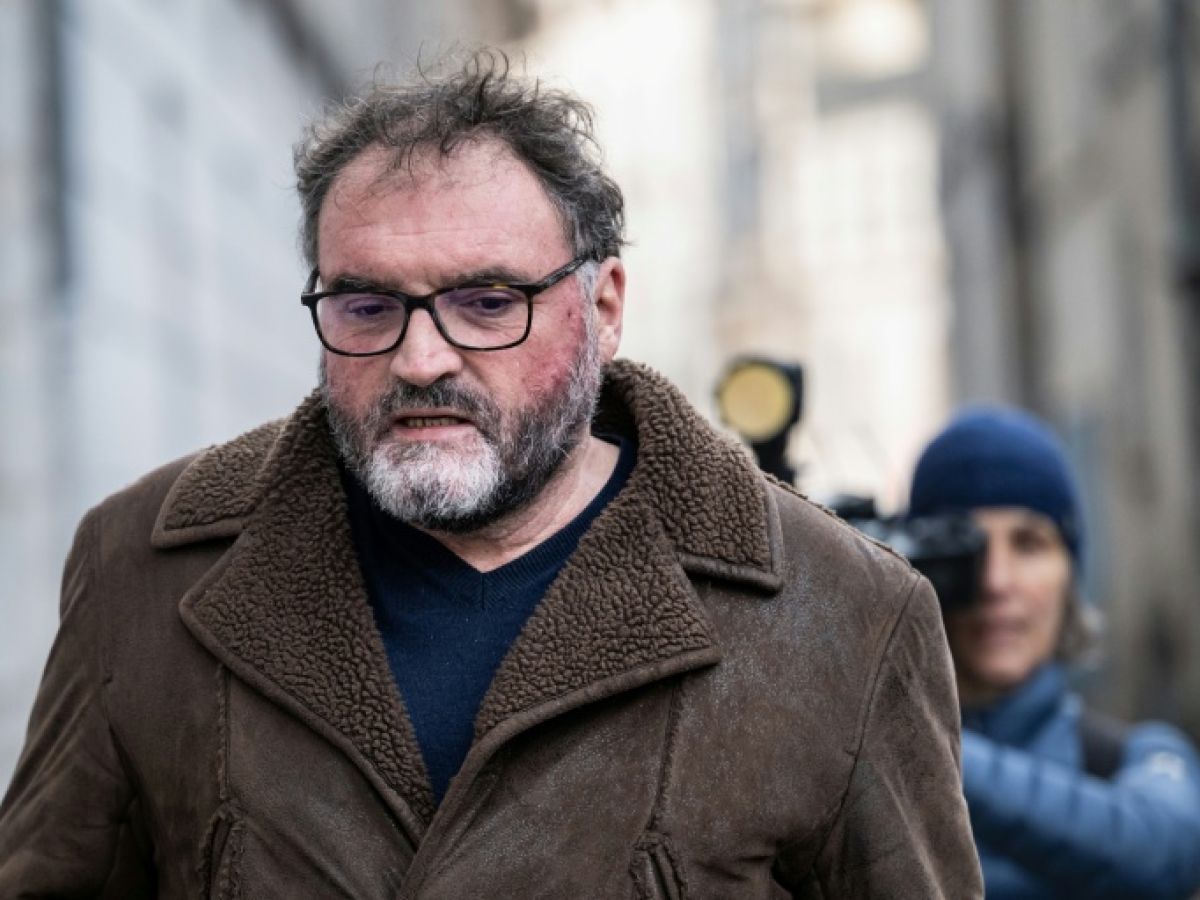
"I am not a poisoner," Frédéric Péchier, an anesthesiologist from Besançon who faces life imprisonment, proclaimed one last time on Monday, before the Doubs Assize Court retired to deliberate at the end of three and a half months of a grueling trial.
"For eight years I have been fighting against being portrayed as a poisoner," but "no, I am not a poisoner," said the 53-year-old doctor.
Accused of poisoning 30 patients, 12 of whom died, between 2008 and 2017, the man in his fifties claims to have "always respected" the Hippocratic Oath.
The court will have to decide.
After 15 weeks of hearings, the jury retired to a secret location to deliberate, presiding judge Delphine Thibierge announced at the close of proceedings. The verdict is expected by Friday.
As for Frédéric Péchier, who has been appearing in court as a free man since September 8, he left the courthouse escorted by law enforcement. He must "remain at the disposal of the justice system" and will not be allowed to leave his residence in Besançon, the magistrate stated.
Last week, at the end of an intense closing argument, the two public prosecutors requested life imprisonment, with a maximum security period of 22 years, against this "serial killer" whose crimes were "highly perverse".
– “To fabricate a culprit” –
But to convict the doctor, "evidence is needed," his lawyer, Randall Schwerdorffer, insisted. However, in this case, "there is a complete lack of evidence," he argued.
Me Schwerdorffer drew a parallel between Frédéric Péchier and Patrick Dils, who spent 15 years in detention for the murders of two children committed in 1986 near Metz, before being acquitted on appeal.
In both cases, "things had to move quickly" to find a culprit, he recounted. From the very beginning of the investigation in March 2017, investigators were "convinced of Frédéric Péchier's guilt" and strove to "prove" it.
“They will never look elsewhere,” he fumed. “They fabricated a scapegoat” and “the entire medical community” ganged up against him. From then on, his fate was “sealed,” according to him.
Frédéric Berna, lawyer for numerous civil parties, judged the comparison to be "particularly dishonest and inappropriate".

"We cannot compare Patrick Dils, who was 16 at the time, who was quite uneducated, who was a very fragile boy, and who moreover confessed, with Dr. Péchier, who is a supremely intelligent man, who was 45 at the time and who never confessed anything."
For Mr. Schwerdorffer, "nothing hallucinatory in the life" of his client "allows us to say that he is crazy", whereas to "kill repeatedly in this way, one needs such rage, such violence".
– “Coincidences” –
But "whatever he says, whatever he does, he will always be criticized," the criminal lawyer laments, and "just as Patrick Dils became 'the child killer, the monster,' Frédéric Péchier has become 'the poisoner, the monster.'"

Certainly, "there is indeed a poisoner at the Saint-Vincent clinic" but it is not Frédéric Péchier, argued the defense, calling on the six popular jurors and the three professional magistrates to be "impartial".
In this case, "coincidences have been made into a rule of evidence, but they are only coincidences," said Mr. Schwerdorffer after the hearing.
"We explained to the jurors that coincidences do not exist and that chance does not exist," but "try explaining that to Mr. Dils – who happened to be near the scene of Francis Heaulme's crime – that chance does not exist," he added.
According to the public prosecutors, Frédéric Péchier contaminated infusion bags used during interventions to trigger cardiac arrests that were incomprehensible to caregivers.
The former anesthesiologist, "one of the greatest criminals in French judicial history" according to the prosecution, thus sought to harm colleagues with whom he was in conflict and "feed his thirst for power".
 English
  French