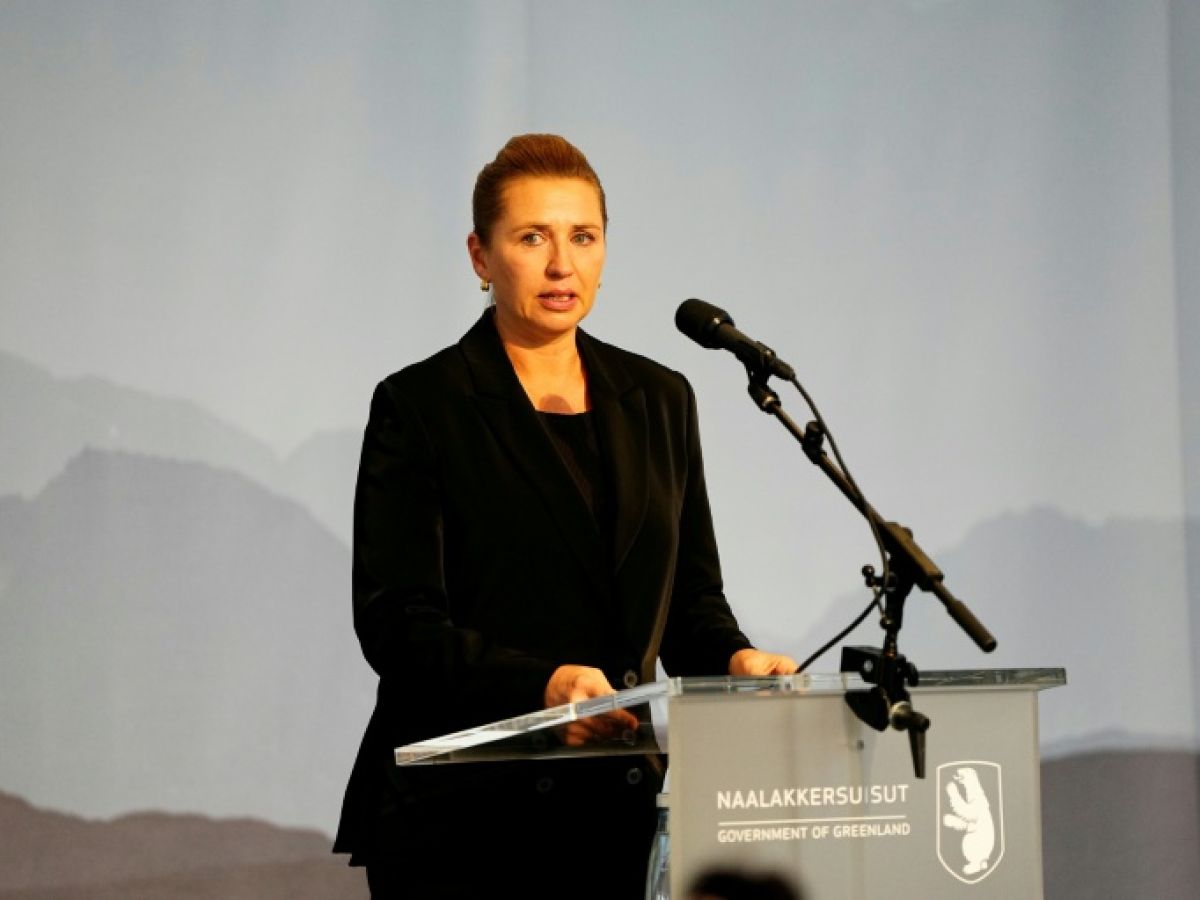
"On behalf of Denmark, I apologize": Danish Prime Minister Mette Frederiksen apologized Wednesday in Nuuk to several dozen women who were victims of forced contraception in Greenland.
The campaign orchestrated by Denmark on the immense Arctic island for more than three decades has left thousands of teenage girls and women dead, sometimes rendering them sterile.
Many of the victims, dressed in black, wiped away tears during the ceremony held this Wednesday in the Nuuk cultural center, listening in silence to the head of the Danish government.
"Today, there is only one thing to say to you: I am sorry for the injustice that was done to you because you were Greenlander. I am sorry for what was taken from you and for the pain it caused you, on behalf of Denmark. I am sorry," said Ms. Frederiksen.

One of the victims, Kirstine Berthelsen, 66, told AFP that the ceremony would allow her "to move forward in my life without hatred, anger and negativity eating away at me from within."
Having come from Denmark for the occasion, she says she is there for "selfish reasons: to see and hear the excuses for two ectopic pregnancies, long hospital stays, surgeries and the removal of a fallopian tube," she says frankly.
The campaign, which began in the late 1960s, aimed to reduce the birth rate in Greenland.
By the end of 1970, at least 4,070 women, or one in two Greenlandic women of childbearing age, had received an IUD, according to a survey presented in early September. The procedure was mostly performed without prior consent, even when minors were involved.
-"We do not accept"-
Speaking before the Danish Prime Minister, the Greenlandic Prime Minister distanced himself from Ms Frederiksen's remarks.
"This apology does not mean that we accept what happened. We are here today because we do not accept what happened," said Jens Frederik Nielsen.
At the end of August, the Danish Prime Minister apologized to the victims in a statement, responding to a request made by the women several years ago.
On Monday, she announced the creation of a "reconciliation fund" to compensate them and other Greenlanders discriminated against because of their origin in other cases.

"This is very good news because my clients are not satisfied with a simple apology," Mads Pramming, lawyer for some 150 victims who are suing the Danish state for violations of their human rights and seeking compensation, told AFP.
"The timing is good, she would not have been well received if she had not offered something in advance," he added.
– “External pressure” –
Between Nuuk and Copenhagen, there are many stumbling blocks, particularly forced adoptions or the forced placement of Greenlandic children in Denmark.
The Danish government is seeking to ease tensions at a time when Greenland is coveted by Donald Trump's United States.
"It's pressure from outside, particularly from the United States, that is forcing Denmark to increase its efforts," said Aaja Chemnitz, MP, who represents Greenland in the Danish parliament. "I've been an MP for ten years, and I've never seen so much effort before."
Mette Frederiksen broke with the tradition of her predecessors, who insisted that Denmark had nothing to apologize for.
"Danish prime ministers have been extremely reluctant to acknowledge the injustices committed in Greenland in the past," says historian Astrid Andersen, a researcher at the Danish Institute for International Studies.
On the "anticonception" issue, as it is called in Greenland, it was the speech of a victim and then a series of podcasts in 2022 that revealed to the general public the existence of this contraception campaign, forgotten by the public authorities and repressed by the victims.
Another investigation into the legal implications of this campaign is underway. Its report, which is expected to examine whether Denmark committed "genocide," is due to be published in spring 2026.
 English
  French