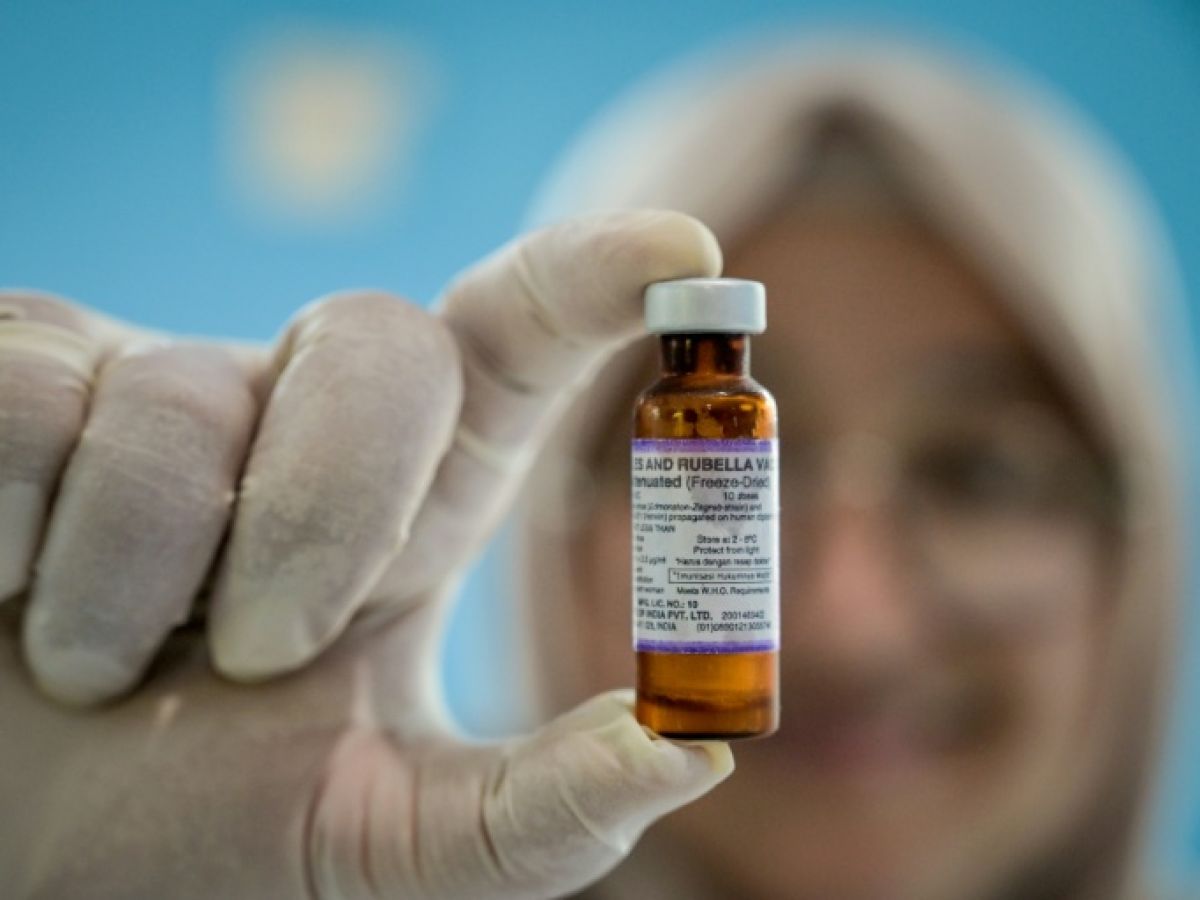
Her fears, which arose from a fever in her firstborn after a tuberculosis vaccination, were fueled by messages on social media claiming that vaccines cause paralysis, behavioral problems or worse. "These kinds of publications worried me and made me think that my decision not to vaccinate my children was probably the right one." testifies this 40-year-old woman reached by telephone from Banten, on the large island of Java.
Fitri illustrates the government's challenge in the face of a major public health crisis in this country of 280 million inhabitants. With more than 8,000 suspected cases and 10 deaths in the first three months of 2026, Indonesia is the second most affected country, after war-torn Yemen, according to the Indonesian Pediatric Association.
Measles "has once again become a significant threat to public health"

In 2025, the country recorded 63,000 cases and 69 deaths, double the number of the previous year. Just when it was on the verge of being eradicated globally, measles... "has once again become a significant threat to public health" in the country, according to an article published in theIndonesian Journal of Internal Medicine in January 2026.
“As a mother, it’s normal for me to be nervous,” Fitri adds again. But I try to maintain my children's good health by giving them nutritious food and vitamins."

“A strong anti-vaccine sentiment (…) has emerged in urban areas.” Due to misinformation, MP Putih Sari warned last month. A study conducted around the same time by the Indonesian company Drone Emprit revealed the presence of anti-vaccine rhetoric on almost all social media platforms.
“Anti-vaxxers, although fewer in number, are generally (…) more virulent than pro-vaxxers,” commented the company's founder, Ismail Fahmi. Influencers are taking advantage of this to sell herbal remedies whose effectiveness has not been proven.
"The result of this misinformation is that our herd immunity has declined."
In March, AFP's fact-checking team debunked claims that the disease would provide better protection than the vaccine. "The result of this misinformation is that our herd immunity has declined.", notes Riris Andono Ahmad, epidemiologist at Gadjah Mada University in Yogyakarta.
Herd immunity is achieved when a sufficient number of people within a given population have been vaccinated against an infectious disease to prevent its spread. In this predominantly Muslim country, where pigs are "haram" or forbidden, many hesitate for religious reasons, as some vaccines contain components of porcine origin.
Thus, Yusran, a 46-year-old entrepreneur, has not vaccinated any of his five children because he fears the ingredients are not "halal" or permitted by Islam. "Even without the vaccine, my children are doing very well." "This resident of Makassar, on the island of Sulawesi (Celebes), assures us, preferring to remain partly anonymous.
The Indonesian Ulema Council, the authoritative Islamic body, nevertheless issued a fatwa in 2018 authorizing vaccines even if they contain porcine gelatin.
Read alsoMeasles: Vaccination rates remain below pre-Covid levels, warns WHO
Indonesia aimed to eradicate measles and rubella by the end of 2026, a goal that now seems unattainable.
Engaged in a race against time to eradicate measles and rubella this year, the Indonesian government has been conducting a mass vaccination campaign since March 9, 2026, with measles and rubella (MMR) vaccine boosters for more than 220,000 health workers.
The government is working with religious organizations to encourage families to vaccinate their children, explained Indri Yogyaswari, director of vaccination, assuring that the spread of measles "has decreased significantly" thanks to this campaign.
Indonesia aimed to eradicate measles and rubella by the end of 2026. But this goal seems unattainable, says Mr. Riris, because it would require 951 third-time recipients (TP3T) of children to have received two doses of the combined vaccine, compared to 77.61 TP3T today.
 English
  French