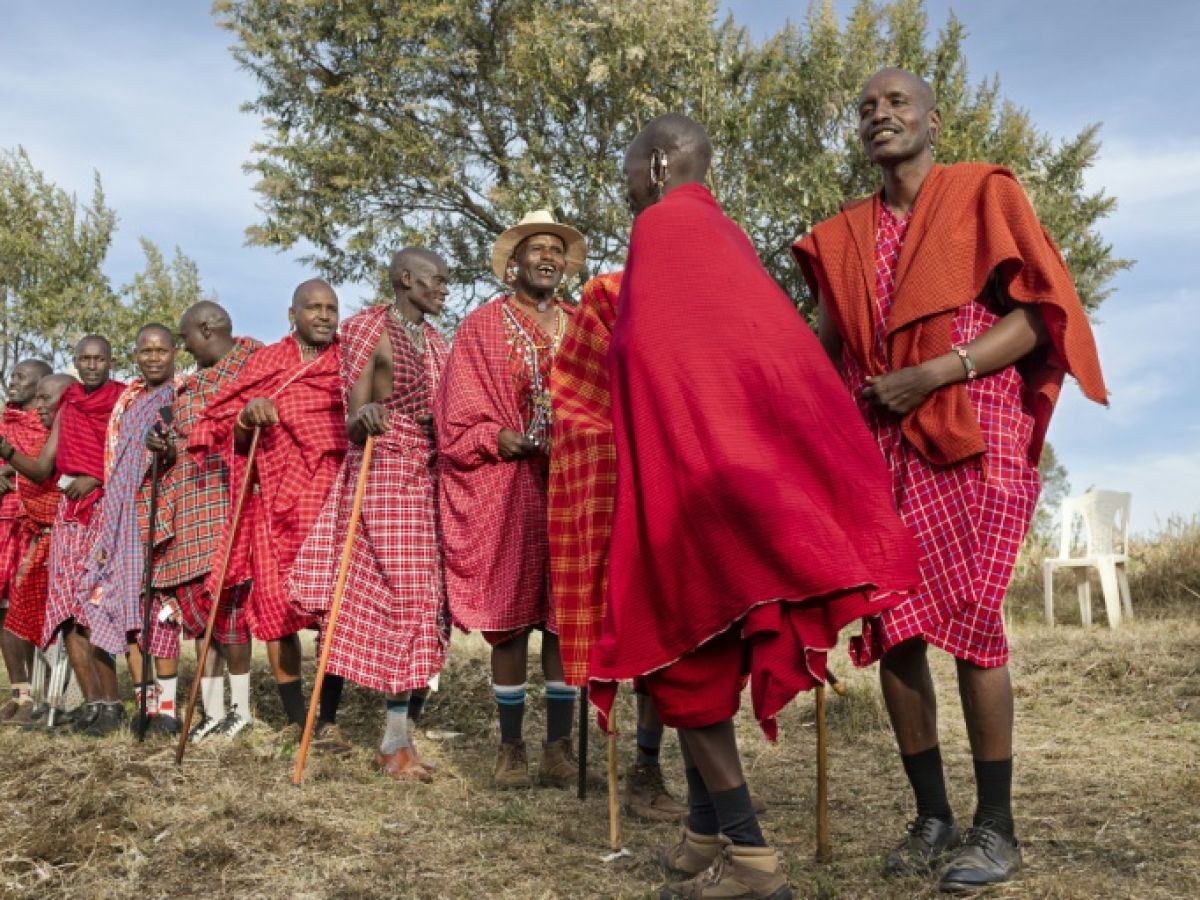
Maasai women burst into bitter laughter when a community elder, draped in a traditional red blanket, assures them that female genital mutilation has virtually ceased within their community in southern Kenya.
They know that female genital mutilation, consisting of removing the clitoris and labia minora – and presented as a rite of passage – remains a deeply entrenched practice in some remote villages of Narok County, yet only a few hours from the capital Nairobi.

In these underdeveloped areas, far from any paved road, approximately 801,000 girls are still affected, laments a nurse. Yet, a law made female genital mutilation illegal in 2011.
"Why are you telling people you've stopped, when we have teenage girls arriving at the hospital after being circumcised?" a woman shouts in a crowd gathered in the village of Entasekera to discuss the issue.

The women nodded vigorously in agreement, in the face of impassive men.
"We no longer perform female genital mutilation on girls because the culture has changed," Moses Letuati, 50, told AFP, before admitting that one of his four daughters had been circumcised.
Several communities in Kenya still practice female genital mutilation (FGM), despite ongoing pressure to stop, first from British colonizers, then from Kenyan and international NGOs.
Apart from some Maasai, for whom girls must be mutilated in order to be married, the Somali diaspora living in the northeast of the country still experiences rates of excision exceeding 90%.
While the proportion of circumcised adolescent girls fell from 29% to 9% in Kenya between 1998 and 2022, according to a government survey, the practice persists even in urban areas, via FGM which is now medicalized.
– Cries and curses –
"I was screaming and struggling," says Martha, 18, who was 10 years old when two women circumcised her at her home in eastern Narok County.

It took her a month to heal, she said. Her mother and sister explained to her that it was her father's decision.
Forced to marry a 25-year-old man, she fled to a shelter run by Patrick Ngigi, founder of the organization Mission with a Vision, which has rescued some 3,000 victims of FGM since 1997.
The shelter, supported by the United Nations Population Fund (UNFPA), is secured by cameras and its residents have access to alert boxes to protect them from their own communities.
Patrick Ngigi admits to having "many enemies": he has been targeted by curses, as have girls who refused to undergo female genital mutilation. But for him, the solution lies in dialogue and ending corruption.
"When a police officer arrives and catches (someone practicing these mutilations), all they have to do is give him something to be able to continue," he laments.
An accusation rejected by Raphael Maroa, a local police officer, who nevertheless acknowledges that the fight against female genital mutilation is arduous, with many girls now being taken discreetly to neighboring Tanzania to be mutilated.
He points to the community's lack of education — about half of Narok's residents are illiterate, according to 2022 figures — before admitting to AFP that his two daughters were circumcised to avoid "a conflict with (his) parents."
– “Monstrous” practice –
The Maasai remain among the poorest communities in Kenya. For decades, they have lost their lands, seized by settlers and then tourism, and some remain wary of foreigners who try to change their way of life.

Although official rates of female genital mutilation have decreased in Narok County, many cases go unreported, according to Rhoda Orido, head nurse at the county hospital.
Nurse Loise Nashipa, 32, from the Entasekera health center, describes FGM as "monstrous": "There is bleeding, pain and infections," she denounces, most of the mutilations still being carried out, according to her, by elderly women using undisinfected blades.
The victims often then suffer from fistulas and complications during childbirth.
At the shelter, the girls celebrate the psychology graduation of Cecilia Nairuko, 24, a resident who fled female genital mutilation and a forced marriage at 15.
His journey delights Patrick Ngigi, who nevertheless emphasizes that his work is never finished. During the gathering in the village, he says, some women discreetly approached him to beg him to take in six girls they believed were in danger.
Cecilia Nairuko beams as she dances in her graduation gown. But like many other residents, her face darkens when she talks about her family: her father and three of her four brothers have never forgiven her for not having undergone female genital mutilation.
 English
  French