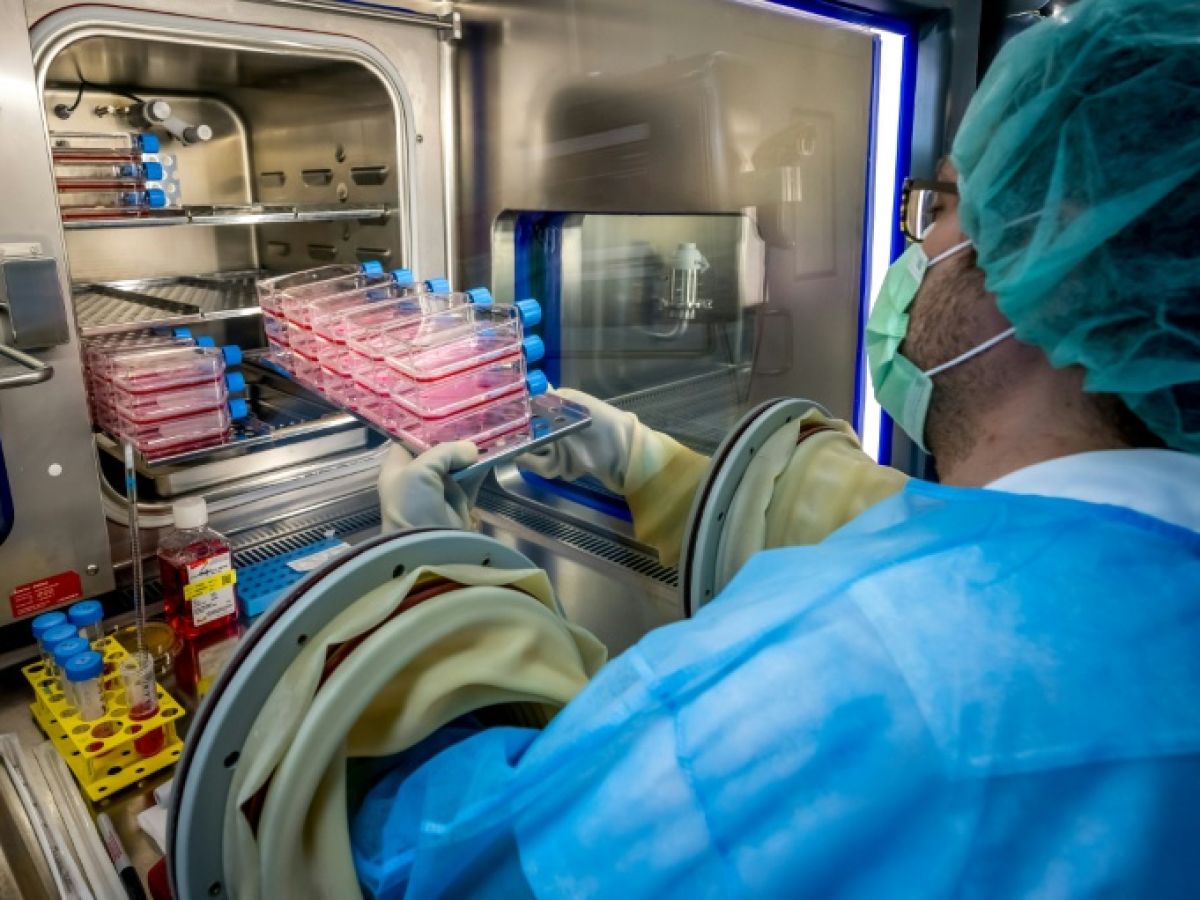
"There is emotion involved." but "For now, we're focused on action. The priority is to help these patients as much as possible." whether they are hospitalized in Switzerland or abroad, Laurent Carrez, the pharmacist in charge of technical matters for the center, located in the Swiss municipality of Epalinges, near Lausanne, told AFP.
Since the tragedy in Crans-Montana, which left 40 dead and 116 injured, dozens of whom are still hospitalized, "We work seven days a week", he said. This center – the only one capable of producing so much cellular tissue for the skin while respecting Swiss and European legislation according to the University Hospital of Lausanne (CHUV) – works with pieces of healthy skin taken from the burn victims of Crans-Montana, in order to avoid the risks of rejection.
This center plays "a very important role"
"From 10 square centimeters of healthy skin, we are able to produce between 1 and 3 batches of 2,600 square centimeters. The 2,600 square centimeters roughly represents the surface area of a back," explains Mr. Carrez, who specifies that these body tissues, resulting from cell reproduction, are not, however, equipped with hair or sweat glands.
So far, the center has received 15 requests for skin fabrication related to the Crans-Montana fire, whereas normally it produces it for about twenty patients per year.
This center plays "a very important role" because "from 50 to 60%" of burned body surface area, " "We have to cultivate skin in laboratories because we wouldn't be able to do it simply by using the remaining healthy skin." explains Dr. Olivier Pantet, a specialist in severe burns at CHUV, to AFP.
Read alsoA man with severe burns (95%) is saved thanks to a skin graft from his twin brother.
"We received the patients' biopsies. We collected and stored their cells."
In a clean room, pharmacy technicians and medical analysis technicians, in laboratory attire, work quietly around culture media – a nutrient preparation – in which skin cells are bathed to reproduce.
So far "We received the patients' biopsies. We collected and stored their cells." And "We are now going to begin the second phase, which is the most critical: the multiplication of keratinocyte tissue, that is to say, skin tissue."Mr. Carrez explains.
This phase should last approximately three weeks, during which the cells, placed in boxes, multiply naturally until they touch each other and then form layers by stacking on top of each other.
“Then, at a certain point, they will stop rising, and that’s when we know they’re ready. You can also see it in the appearance of the cell (…) They have reached the desired function, that is, their function as tissue.” And "are ready to do the equivalent of a skin"Mr. Carrez describes. Next comes the work of coordinating with hospitals to "grafting these skins" who, once "reached maturity"must be placed in "the two days that follow."
Read alsoSeverely burned patients treated with fish-skin dressings
"If 80% of the transplants take, we are very happy; it's an excellent result."
The success of these transplants is not always guaranteed. "If 80% of the transplants take, we are very happy; it's an excellent result."Dr. Pantet of the CHUV, an institution currently treating seven severely burned patients from Crans-Montana, points out that while awaiting these skin grafts, doctors can apply airtight dressings, pieces of skin from deceased donors, or fish skin to the burned areas.
According to initial findings of the investigation, the tragedy was caused by sparks from candles. "fountain" They came into contact with acoustic foam installed on the ceiling of the basement of the burned-down bar. According to Dr. Pantet, many of the injured in Crans-Montana share the characteristic of having burns over a large area and also deeply.
To treat these severely burned patients, the CHUV, given their lack of skin barriers, ensures that they are hydrated and that their temperature is controlled: they are admitted into spaces heated to a high temperature, around 30 degrees, with particularly high humidity.
Once the grafts have been carried out, doctors must also ensure the positioning of the joints during the healing process, including the use of splints, before a long rehabilitation process, explains Dr. Pantet.
 English
  French