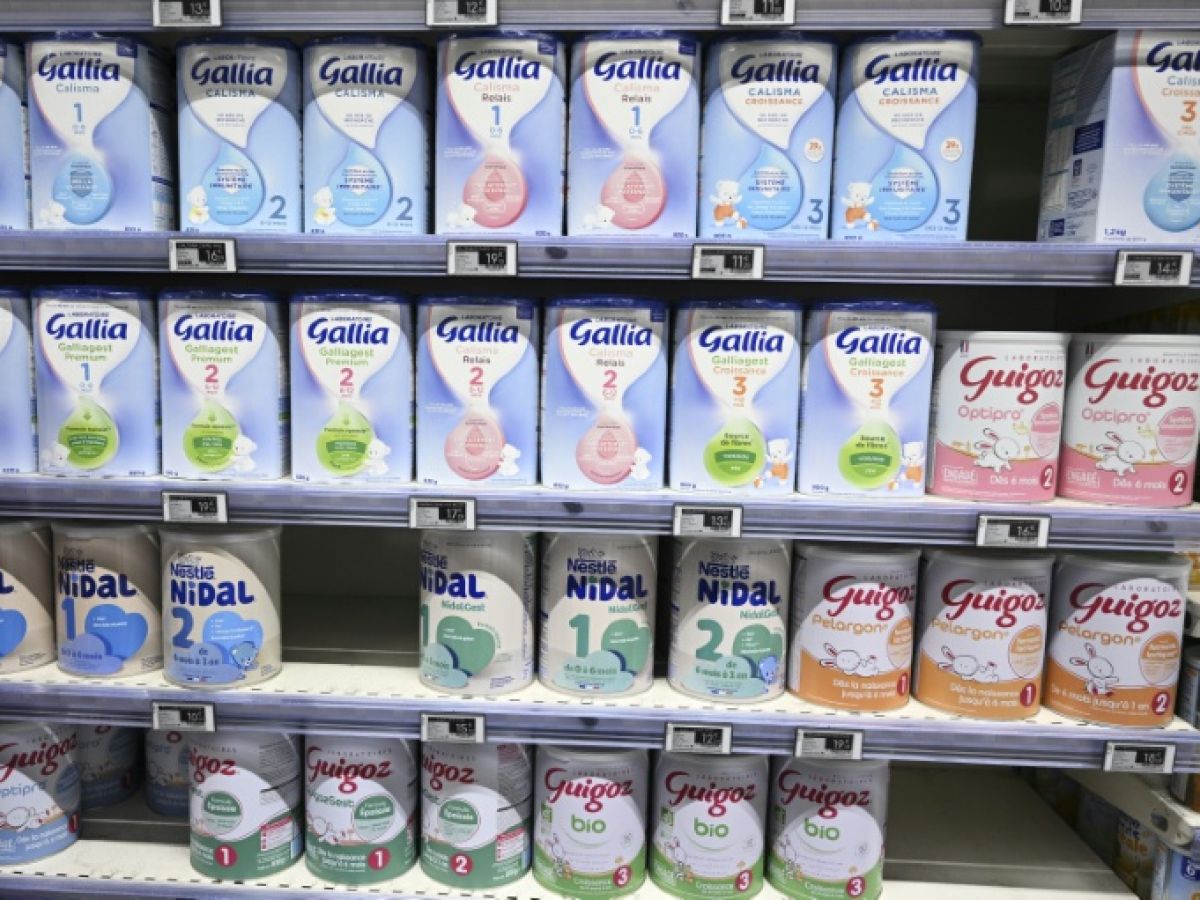
The Paris administrative court rejected the appeal filed by a children's health advocacy group for "serious failure by the State in managing the contaminated infant milk health scandal," while the government defended itself before parliamentarians.
"In view of the public statements of the Minister of Health on January 23, 2026, affirming that 'all infant milks concerned by cereulide contamination have been withdrawn from circulation' and that 'the situation is under control', the elements of the request do not reveal (...) any clear failure on the part of the State," notes the judge of the summary proceedings in his order consulted Wednesday by AFP.

The administrative judge also considers that the association's requests for "public communication measures, due diligence in investigation, enhanced microbiological monitoring (...) are not among the emergency measures" that the judge in summary proceedings can take.
Consequently, "the request of the Association for Children's Health is rejected."
The association denounced on Wednesday "a decision without real investigation, based solely on government promises" and is considering appealing to the Council of State.
Several manufacturers, including industry leaders Nestlé and Danone, as well as Lactalis, have recalled infant formula in more than sixty countries, including France, since December due to a risk of cereulide contamination. This toxin is produced by bacteria and, according to authorities, originated from a Chinese ingredient supplier.
In its request, the association asked the State to order within 24 hours the recall of all infant milks containing arachidonic acid-rich oil (ARA) produced by the Chinese industrialist Cabio Biotech, which has been implicated by several infant milk producers.
Its president, Quentin Guillemain, had notably criticized to AFP the one-month delay "to begin withdrawing the products".
The association continues to demand transparent information, with a dedicated website and a criminal investigation into the whole case and not just the cases of two infants, in Bordeaux and Angers, who died after consuming Nestlé milk that had been recalled – with no link established at this stage according to the authorities.
The government was questioned twice on Wednesday, first in the National Assembly and then in the Senate. MP Boris Tavernier (Greens) criticized the government's response, which, according to him, "left the crisis to industry" and failed to apply "the precautionary principle." Senator Florence Lassarade (The Republicans), a former pediatrician, was less vehement, though she did question the timing of the recalls.
The Minister of Agriculture and Agri-food, Annie Genevard, defended herself by stating that the procedures had been "very, very well respected": "The role of the State is to be present at each stage to verify that things are done correctly. And that is what we did."
"The obligation of safety lies with the manufacturers (...) the procedure was initiated on the very day that the self-check carried out by Nestlé actually revealed the presence of a toxin," she added.
Once the source of the contamination was "found", "an alert was issued to all industrialists" who carried out recalls as the analyses progressed, the minister added.
The European Food Safety Authority (EFSA) also indicated on Wednesday that it had been asked by the European Commission to establish a standard for cereulide in children's products. It will issue its opinion on February 2nd.
 English
  French