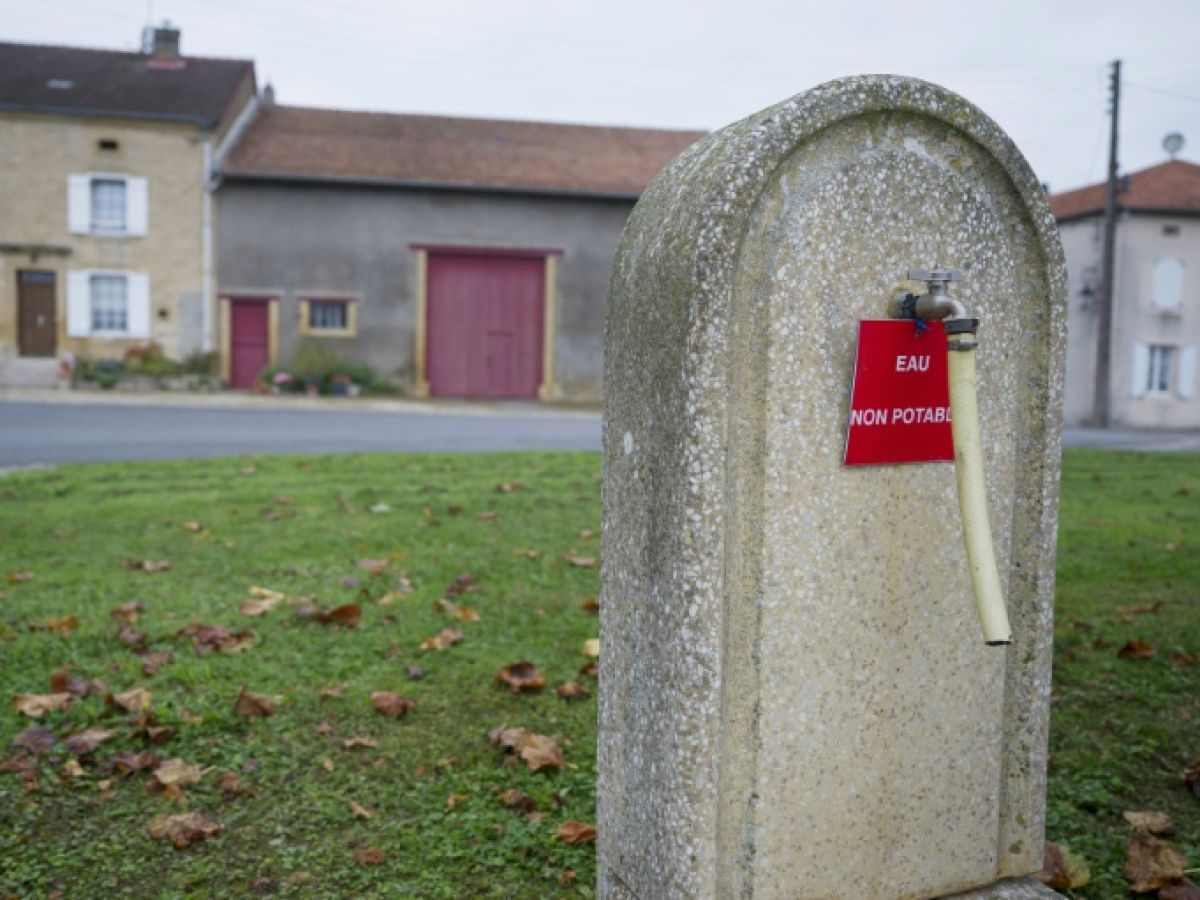
In these municipalities of the Meuse, Ardennes or Vosges, the concentrations in the water of 20 PFAS (per- and polyfluoroalkyl substances), with potentially harmful effects on human health, clearly exceed the authorized thresholds — up to 27 times the limit in Villy (Ardennes), a record.
Epicenter of the pollution: a paper mill in Stenay
With no factories visible in the distance, the hypothesis of contamination by sewage sludge from nearby industries quickly became a certainty in these rural areas. In the Meuse department, where four villages are affected, investigations conducted since the summer have shown that the pollution originates from compost and sewage sludge spread to fertilize fields from a paper mill in Stenay, which closed in November 2024. The 16 municipalities in the Meuse and Ardennes departments, representing a total population of 3,400, affected by the water consumption bans are all located within a radius of about twenty kilometers around this former factory.
Regulations that do not require testing for PFAS

The waste from this paper mill was distributed by direct spreading of sludge and also via a composting unit "from a company that spread this compost" since 2007 on 225 hectares of arable crops", including 50 hectares in a " catchment area"According to the prefecture, the latter has seized the compost still present on the site and reported it to the public prosecutor's office." serious breaches of spreading rules“.
The German fund Accursia Capital, which took over the factory a few months before its liquidation, claims to have used " no products containing PFAS" . " Production was limited to certain specific product lines and did not require the use of this type of compound.", its president, Oliver Würtenberger, told AFP, placing the blame on the " specialized companies that are legally responsible "of sludge disposal."

According to a former employee of the factory, who asked to remain anonymous, regulations did not, however, require testing for PFAS, but only heavy metals", so that " everything was as described" . However, " There were waste tracking documents that were false." he asserts, with inaccurate tonnages in particular: for him, a greater quantity of sludge was spread.
The use of industrial sewage sludge poses a problem
Several mayors in the Ardennes also suspect illegal dumping of sludge on the Olizy-sur-Chiers plateau in the Meuse. This sludge could then, through runoff or infiltration, pollute the soil and water.

The situation is similar in the Vosges region, where two municipalities are subject to decrees at least partially prohibiting the consumption of tap water. In one of them, Tendon, the town council passed a decree in 2011 demanding a halt to the spreading of sludge, which had been carried out since 1998 on plots of land near a water intake. This sludge came primarily from a laundry facility in Gérardmer, a few kilometers away. Mayor Gérard Clément laments that the decree only came into effect in 2013 for one plot and in 2018 for another, adding that he wishes the dangers of these practices had been addressed sooner.
It's up to local authorities to find solutions?
Especially since it is now up to local authorities to find solutions to make the water drinkable again. And this could be costly, as conventional filtration techniques, particularly activated carbon, are not always effective against PFAS. In the Villy area, the preferred option is to connect the contaminated networks with clean ones to reduce pollution levels in the diluted water. But this is a solution " expensive, very expensive" , underlines Hanafi Halil, sub-prefect of Vouziers, PFAS referent in the Ardennes.
“ A huge gap in the regulations“
The cost is also being passed on to residents, who continue to pay for tap water they can no longer drink, laments Annick Dufils, mayor of Malandry, an affected town in the Ardennes. Because, whether potable or not, the water consumed must be billed, the Rhine-Meuse Water Agency confirmed to AFP, stating that it cannot exempt any particular household. Furthermore, even if local elected officials, who fear for their finances, request it, The polluter-pays principle cannot be applied." explains the Meuse prefecture. We cannot accuse "whoever" for having poisoned the soil with PFAS, since it was not in the regulations“Generally speaking, with PFAS, there is “ua huge gap in the regulations and a legal vacuum", deplores Pauline Cervan, toxicologist for the association Générations futures.
Sewage sludge is tolerated in France but banned in Switzerland.
From January 1st, all water in France will have to be analyzed to quantify the levels of 20 PFAS. New orders prohibiting consumption of the water could then be issued.

For Ms. Cervan, this is a good thing, as is the suspension of spreading near catchment areas, as decided in the Ardennes. But " France is lagging far behind "On this issue," she said. Switzerland, for example, banned the spreading of sewage sludge as early as 2003, recalls Jean-François Fleck of the Vosges Nature Environnement association. France, however, did not, contenting itself in 2006 with creating a guarantee fund for risks related to spreading. We cannot remain in this situation of mutual irresponsibility, especially since we have known about PFAS since the 1950s. France could not have been unaware." insists the environmental activist.
With the aim of sharing their knowledge with their constituents who are worried about the consequences on their health – PFAS can cause cancer, high cholesterol or fetal development problems —, the mayors of three towns in the Ardennes had their own blood tested. The verdict: their blood levels of PFAS exceeded the threshold values in force in the United States and Germany. However, no such threshold has been defined in France, so… He doesn't interpret the results. It's still very vague, a code of silence."This is regrettable," laments the mayor of Malandry, who advocates for the widespread implementation of these tests. Furthermore, the mayor deplores, We are told that it is not possible to conduct a study, an epidemiological monitoring, for such a small population." : " It's always the same problem in rural areas“.
 English
  French