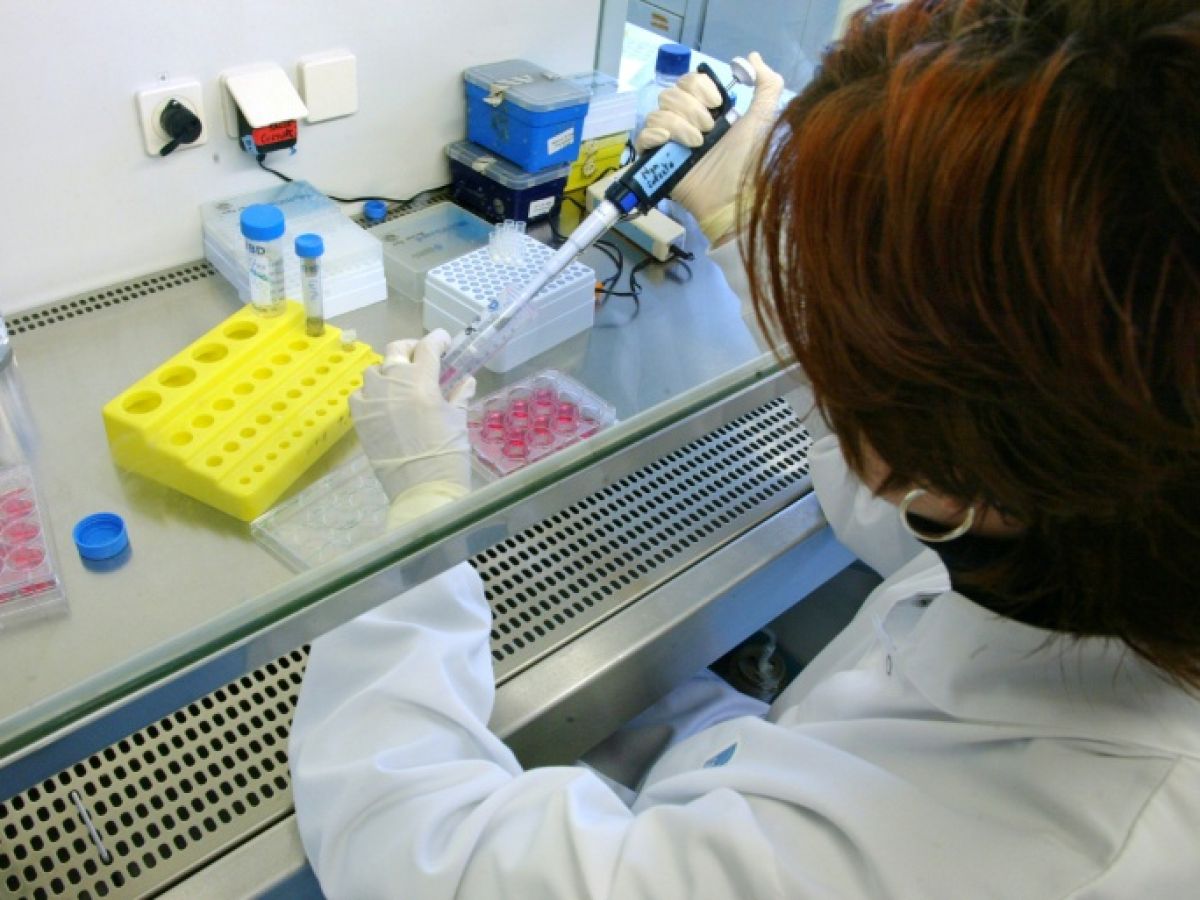
Hope or frustration? For the millions of people living with a rare disease and awaiting a treatment, the picture is mixed. Research is in full swing, but more and more projects are failing due to a lack of funding.
"Today we have drug candidates which we know offer real therapeutic promise but we do not have the means to take them to the end," reported Laurence Tiennot-Herment, president of AFM-Téléthon, a key player in the fight against rare diseases in France, in mid-February.
"This is a frustration I had never experienced before," she insisted during a conference ahead of World Rare Disease Day on Saturday.
These diseases, most often of genetic origin, are considered rare because each affects only a small number of patients – less than one in 2,500 – but they are so numerous – several thousand – that a large number of people are affected. In France, it is estimated that there are more than three million.

For the past thirty years, research into treatments has seen great success. As a result, a large number of patients with cystic fibrosis, one of the most widespread rare diseases, can now benefit from an effective treatment, Kaftrio.
New avenues are emerging. In a study published Friday by The Lancet, American researchers describe how they administered stem cells to fetuses with spina bifida, another rare but among the most common diseases, to help repair their spinal cord.
Although these results currently only concern a handful of children and are far from real-life application, they already illustrate the level of technical expertise achieved by research against rare diseases.
But alongside these successes, those working on the ground are seeing more and more projects remain on the drawing board. For example, AFM-Téléthon, which raises nearly 100 million euros a year during its televised show, is unable to finance the launch of a promising human trial against limb-girdle muscular dystrophy.
This is partly "the price of success," as past achievements have led to a bottleneck of projects, admits Ms. Tiennot-Herment. But the obstacles are also economic, she says, with the private sector sometimes struggling to take over.
– Public incentives –
"We can feel that there has been a slowdown over the last five years, that the pharmaceutical industry is more reluctant," she reports, pointing to the contrast with a real "enthusiasm" in the mid-2010s for gene therapies, at the heart of the fight against rare diseases.
"Between 2015 and 2021, they benefited from a cycle of exceptional scientific and financial enthusiasm," confirms financial analyst Jamila El Bougrini, a specialist in the pharmaceutical sector, to AFP.
But she qualifies the idea of a disaffection of investors, recalling that there has been a general decline in funding for pharmaceutical innovation since the 2020s and that rare diseases have ultimately "held up better" than other areas.
Several pharmaceutical giants – AstraZeneca, Amgen, etc. – now have divisions entirely dedicated to rare diseases. And for several years now, these have accounted for almost half of all drug approvals in the United States.
The fact remains that the term rare diseases covers very different realities, from cystic fibrosis or spina bifida, which are relatively common, to so-called "ultra-rare" diseases which sometimes affect only one person in several million.
For the former, "a company can obtain a return on investment," American health economist David Ridley told AFP. For the latter, "it's much more difficult," he noted, emphasizing that "patient populations are too small."
How can this investment gap be filled? In France, the AFM Téléthon is calling for a research fund that can be financed by a tax on the pharmaceutical industry.
In the United States, an incentive program has just been renewed: when a pharmaceutical group develops a treatment for a rare pediatric disease, it can request an accelerated review procedure for another drug, potentially more lucrative.
Finally, original models are emerging. A foundation created by American parents has just obtained authorization to launch a trial which it is funding from start to finish to test a therapy for F0XG1 syndrome, affecting about one in 30,000 children, a funding mechanism never before seen.
 English
  French