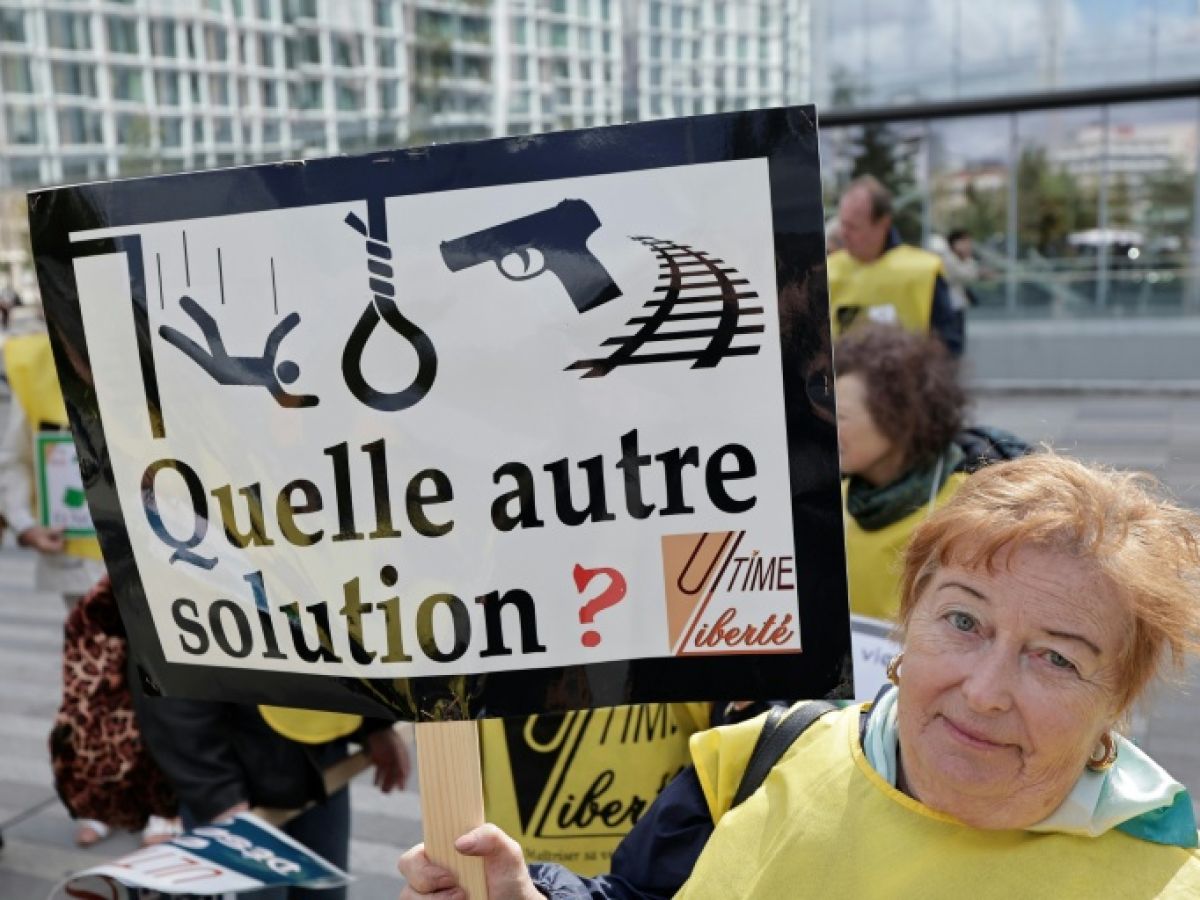
Amid parliamentary debates on end-of-life issues, the Paris criminal court on Friday sentenced twelve radical assisted suicide activists to suspended prison terms of up to 10 months for trafficking barbiturates.
Twelve members of the Ultime Liberté association, aged 75 to 89, were tried between mid-September and early October and were all found guilty of having, between August 2018 and November 2020, helped dozens of people to buy pentobarbital online, a barbiturate that causes a quick and painless death.

These retirees, who were only being prosecuted for offenses related to trafficking in illicit substances and not for inciting or assisting suicide, had made their trial this fall a platform for assisted dying.
The sentences handed down range from a fine of 2,000 euros, of which 1,000 is suspended, to 10 months' suspended prison sentence for the founder of the association, Claude Hury, whose "amateurishness in accompanying" people wishing to die was condemned by the judges.

In front of a packed courtroom of elderly people who came to show their support, reflecting the tone of the audience, the president of the 31st chamber began by stating that "the court is not disconnected from societal issues and their evolution. It is perfectly aware of the movement desired by the vast majority of French people regarding end-of-life care."
However, while the Senate is examining this month the bill creating a right to assisted dying, which would significantly change French legislation, "defendants cannot expect a correctional court to act as a legislator and anticipate the advent of a law."
Even though their action was motivated only by their humanitarian commitment, practiced outside of any medical framework, the court was concerned about the "extremism" of some of the activists advocating "unlimited freedom" to end their lives, beyond the case of sick and suffering people.
Highly divisive, born in 2009 from the split of the most radical fringe of the large pro-euthanasia organization ADMD, Ultime Liberté claims the right to a "peaceful" suicide for any person in full possession of their faculties, sick or not.
– “We didn’t kill anyone” –
"We didn't kill anyone, we simply helped. We made a gesture of humanity towards people who were asking for help," reacted Claude Hury, a 76-year-old retired professor, after the verdict, announcing that she would appeal the decision.
One of the defense lawyers, Frédéric Verra, welcomed "a relatively symbolic sentence which shows the court's embarrassment."
Activist doctor Bernard Senet, who admits to having performed euthanasia during his medical career, was sentenced to six months in prison with a suspended sentence.
With its parade of expert doctors and intellectuals, as well as anonymous individuals who helped their loved ones end their lives, the trial revealed to the court the hidden world of assisted dying for the suffering of the sick. An illegal act, yet one practiced throughout France, in the secrecy of families, behind closed bedroom doors.
In a testimony as unexpected as it was moving, a priest came to the stand modestly to confess that, contrary to religious dogma, he had resorted to assisted suicide for his father who was suffering from terminal cancer.
“He made me swear to shorten his suffering when the time came. It was a double punishment for me because I kept my word. As a son, it was very difficult to live with. As a Christian and a priest, it was almost schizophrenic: ‘Thou shalt not kill’,” said this imposing cleric in a black cassock and Roman collar, quoting the Bible.
Drawing parallels between the assisted dying movement and the campaign for the legalization of abortion in the early 1970s, many witnesses welcomed the legislative and societal progress that they believe the text voted on in its first reading in May by the National Assembly, which the Senate will debate at the end of January, would represent.
This bill, proposed by MoDem MP Olivier Falorni, would create a "right to assisted dying" in France. It would legalize assisted suicide and, in exceptional circumstances, euthanasia, although these terms, considered to have negative connotations, do not appear in the text.
 English
  French