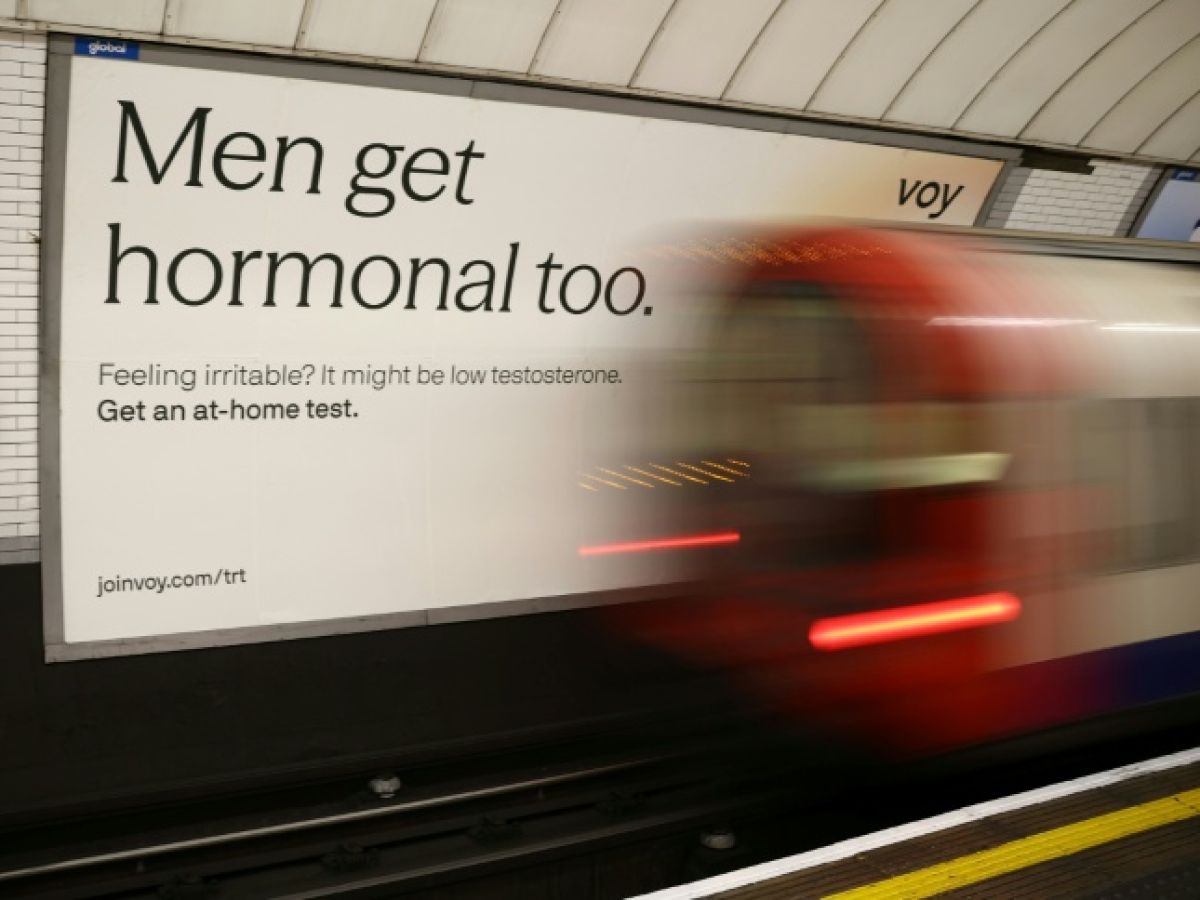
Encouraged by influencers and advertisements touting their beneficial effects on dynamism or libido, more and more men are embarking on treatments to boost their testosterone, often without medical justification, according to doctors interviewed by AFP.
On social media or in the London Underground, private health centers encourage men to test their testosterone levels, in order to then promote these medical treatments.
"Are you tired, unfocused, and having trouble recovering after your workouts? It might be time to check your testosterone levels," suggests one advertisement among many on the internet.
Male hormone levels vary according to age and lifestyle, and studies conducted in the United States and Europe show a decline in testosterone levels in men over several decades, which scientists attribute in particular to environmental factors.
But private medical centers are currently prescribing testosterone replacement therapy (TRT) to men who "do not need it at all," says Channa Jayasena, professor of endocrinology at Imperial College London.
Although private companies are not required to disclose their data, he estimates that "hundreds of thousands" of men in the UK have used TRT.
– The numbers are “exploding” –
And many British patients, after a test carried out in a private centre revealing a low level, turn to the National Health Service (NHS), the public health service, to benefit from free treatment.
The number of men requesting such treatment has "literally exploded," according to Dr. Jayasena. "This is a huge problem for us, affecting our ability to treat other patients," he said.
"I see advertisements claiming that one in four or five men under 40 has a testosterone deficiency. This is absolutely not true," Australian endocrinologist Isobelle Smith, who has been working to debunk these treatments on social media, also told AFP.
"These companies are saying that perfectly normal levels are low," she said.
TRT is necessary in cases of male hypogonadism, a disorder characterized by a severe testosterone deficiency and which can manifest as a lack of puberty in adolescence. However, these doctors also warn that the treatment can cause side effects including infertility, high blood pressure, high cholesterol, and blood clots.
Prescriptions for these treatments by public sector GPs increased by 13% in 2024 in England, according to the UK health services regulator, the Care Quality Commission.
– Manosphere –
Some link the enthusiasm for these treatments to the "manosphere," online forums where masculinist movements are expressed.
One of its leading figures and self-proclaimed misogynist, Andrew Tate, boasts, for example, of having a "high level" and mocks those with a "low level." And the controversial US Secretary of Health and Human Services, Robert Kennedy Jr., recently praised Donald Trump's high testosterone levels.
Even though, according to Dr. Jayasena, there are no clinical trials proving that increasing testosterone beyond the normal threshold actually improves well-being, the popularity of these treatments is fueled by testimonials from men from different backgrounds who, via social networks, attest to the beneficial effects of TRT.
Gavin McNamee, 41, a sports coach in the northeast of England, confirmed to AFP that he feels "much better" after five months of treatment, having previously felt depressed and without energy.
"I feel like a different person," Carl Graham, 38, a law firm employee in Liverpool, who has been undergoing TRT for more than six months, also told AFP.
Both insist they have no financial interest in these treatments. Having gone through private health centers, they inject themselves with testosterone twice a week, along with another drug to maintain natural production, at a cost of 100 to 200 pounds (between 115 and 230 euros) per month.
 English
  French