
Medicine opened the Nobel Prize season on Monday, October 6, 2025. The announcement of the winner(s) was available to follow at 11:15 a.m. in the video below, live from Stockholm, Sweden. This prestigious prize was awarded to American Mary E. Brunkow, American Fred Ramsdell, and Japanese Shimon Sakaguchi. for their work on how the body controls the immune system, particularly the identification of “guardians of the immune system.”
"The Nobel laureates have identified regulatory T cells, the true guardians of the immune system, thus laying the foundations for a new field of research, explains the Nobel committee. These discoveries have also led to the development of potential medical treatments, currently being evaluated in clinical trials. The hope is to be able to treat or cure autoimmune diseases, provide more effective treatments for cancer, and prevent serious complications after stem cell transplants.
Read alsoNobel Prize in Medicine rewards discoverers of immune 'police of polices'
GLP-1 cited among favorites
Among the favorites for the 2025 Nobel Prize in Medicine were cited research into appetite-regulating hormones, the famous GLP-1, with the names of Danish doctors Jens Juul Holst and Joel Habener, Canadian endocrinologist Daniel Drucker and American chemist Svetlana Mojsov, but also research on ghrelin, an appetite-stimulating hormone, with the names of two Japanese researchers, Kenji Kangawa and Masayasu Kojima.

Also cited in recent years for the Nobel Prize in Medicine was the American biologist Kevan Shokat for his work on mutations in the KRAS gene which causes cell proliferation and can lead to difficult-to-treat cancers, such as lung, colon, and pancreatic tumors. As is the work of neuroscientists Ann M. Graybiel, Okihide Hikosaka, and Wolfram Schultz on the neural mechanisms that guide our behavior. Or research on epigenetics, embodied by the work of Davor Solter and Azim Surani on the mechanisms within cells that control gene activity without modifying DNA.
MicroRNA discovery to be rewarded in 2024
In 2024, the prestigious award had been handed over to Americans Victor Ambros and Gary Ruvkun for the discovery of microRNAs and their role in post-transcriptional gene regulation. Identified in the late 1990s, microRNAs (often abbreviated as "miRNAs") are short nucleotide sequences that have the ability to pair with target messenger RNAs (mRNAs). Upon pairing, the mRNA is cleaved in two at the binding site, and genetic expression of the protein is blocked. MiRNAs are involved in various major cellular processes such as development, cell differentiation and proliferation, and apoptosis (programmed cell death).
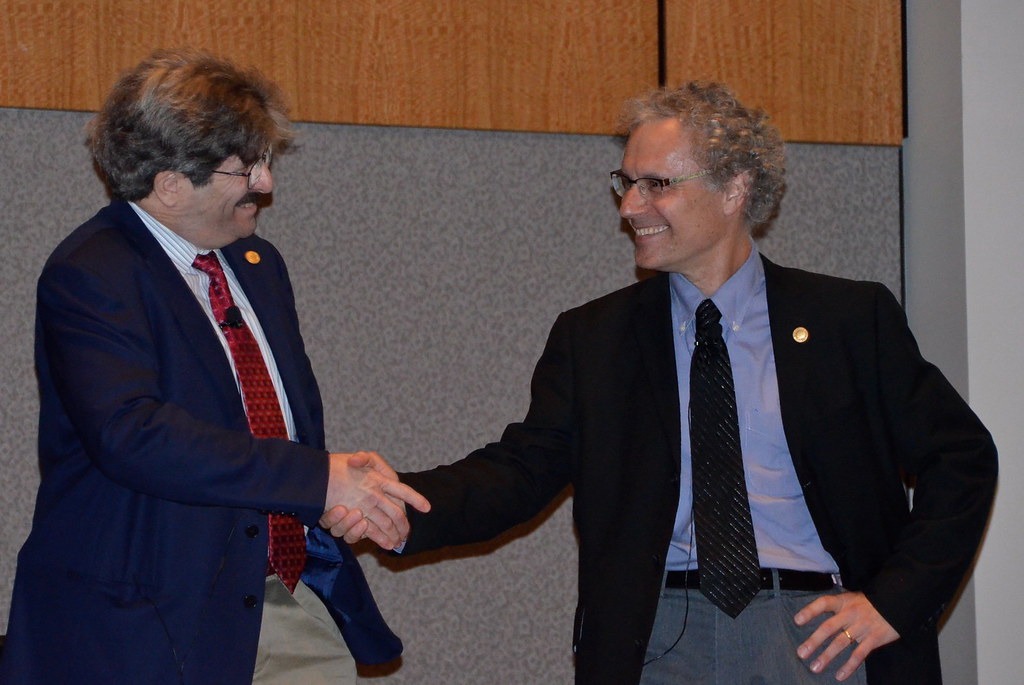
Gary Ruvkun and Victor Ambros in 2014. Credits: Creative Commons CC BY-NC-SA 2.0
In 2023, mRNA vaccines in the spotlight
In 2023, the Nobel Prize in Medicine had been handed over to the American-Hungarian Katalin Karikó and the American Drew Weissman for their work that led to the development of mRNA vaccines. Katalin Karikó and Drew Weissman's landmark discoveries date back to 2005, and the first mRNA vaccines against Covid-19 were subsequently manufactured by Pfizer/BioNTech and Moderna.
In the midst of the pandemic, many people have become familiar with the principle of messenger RNA vaccines: they focus on a small part of the virus—in the case of SARS-CoV-2, the so-called "spike" protein—and aim to inject strands of genetic instructions, called messenger RNA, into the body, instructing the body to produce this protein. Harmless in itself, this coronavirus "spike" is then detected by the immune system, which will produce antibodies.

Chart showing the winners of the 6 Nobel Prizes in 2024. Credits: VALENTINA BRESCHI, SYLVIE HUSSON / AFP
The 2025 Nobel Calendar
- Tuesday, October 7 from 11:45 a.m.: Nobel Prize in Physics
- Wednesday, October 8 from 11:45 a.m.: Nobel Prize in Chemistry
- Thursday, October 9 from 1 p.m.: Nobel Prize for Literature
- Friday, October 10 from 11 a.m.: Nobel Peace Prize
- Monday, October 13 from 11:45 a.m.: Nobel Prize in Economics
 English
  French