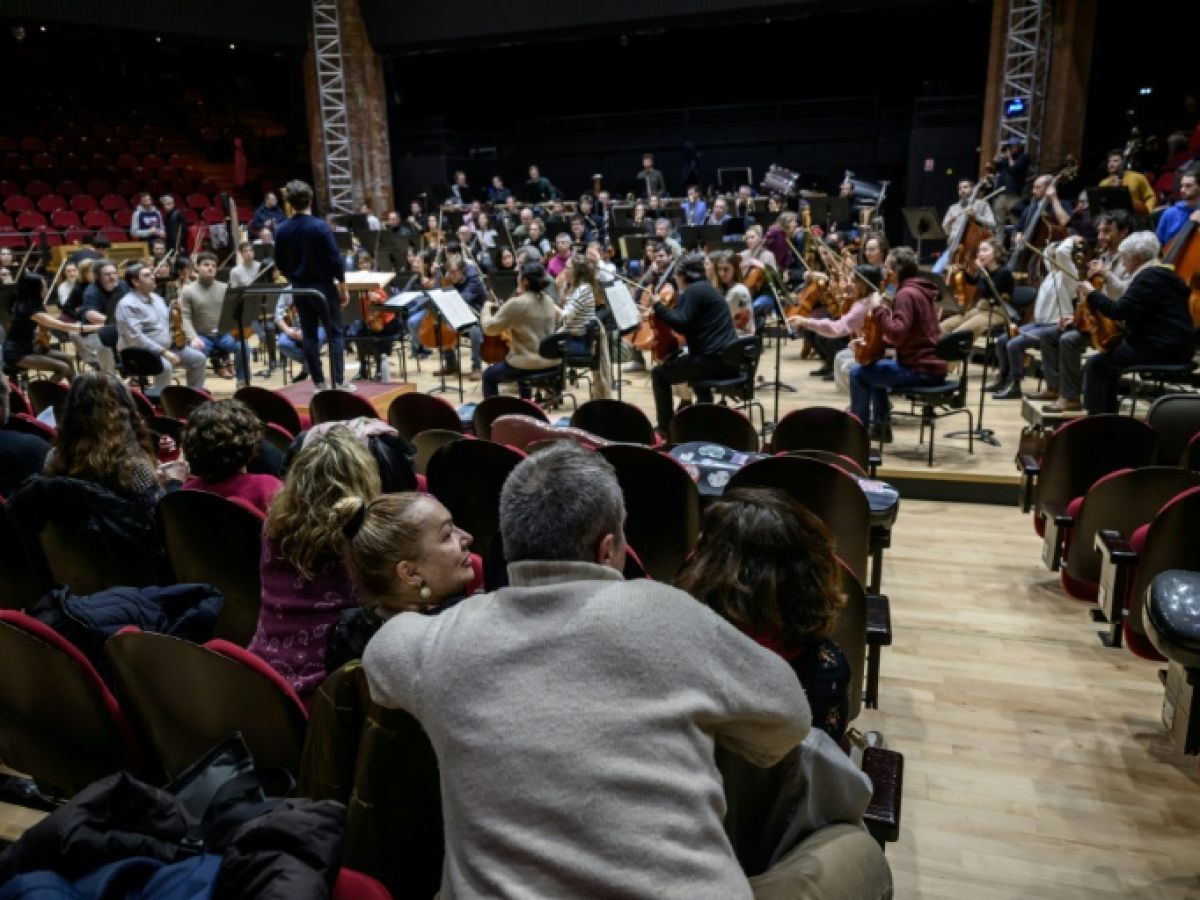
To break the vicious cycle of isolation and self-stigmatization, around twenty psychiatric patients suffering from depression or bipolar, schizophrenic or personality disorders attend rehearsals of the Toulouse orchestra as part of the "Resonance(s)" project which, after three years, is spreading throughout France.
The project was launched in 2023 through a partnership between the Orchestre National du Capitole and several mental health institutions in the region. Its aim, in the face of pathologies that can trap patients in a negative self-image, is to allow them to attend four rehearsals per year to initiate a dynamic of reconnection with others and promote their recovery.

In mid-February, approximately 25 patients from clinics and day hospitals, accompanied by their caregivers, settled in small groups in the spectacular Toulouse concert hall of the Halle aux grains.
Facing them, the musicians are preparing to work on three movements of Hector Berlioz's (1803-1869) Symphonie fantastique, a monument of French romanticism.

The choice to attend rehearsals rather than concerts is not a coincidence: seeing the musicians dressed in T-shirts and hoodies, like them, helps the patients to identify with them.
For two hours, patients ranging in age from their twenties to their sixties listened attentively, sometimes taking notes. A young man closed his eyes for a few moments to let himself be carried away by the music.
– Melancholy –
After the rehearsal, the protocol includes a time for discussion with members of the orchestra.
Patients and caregivers alike showed great curiosity towards the musicians present, violist Claire Pélissier and oboist Serge Krichewsky. The discussion then focused on the third movement of the Symphonie fantastique, which opens with a melancholic dialogue between oboe and English horn.
"From the moment you played the third movement, I cried a lot," a patient confided to the instrumentalists. "It allowed me to release a lot of emotions; I arrived very tense (at the rehearsal). I was carried away by the emotion," she continued.
Psychiatrist Nathalie Bounhoure, who initiated the project, specializes in "psychosocial rehabilitation." She wanted to situate Résonance(s) within this field of psychiatry, which attempts to help patients "shift away from the burden of diagnosis" and "rediscover themselves as individuals."
“It really helped me get back on my feet, to feel grounded, to understand that my emotions come and go… These are things that happen every day, all the time, but at least with music, we’re not alone,” Naémi, a 25-year-old patient, told AFP. “We feel entitled to be in this fluctuation, because music fluctuates too.”
– “Breaking the solitude” –
“People who are ill are very isolated in what they are experiencing,” laments Ms. Bounhoure. Yet, “it’s very important to be able to feel the same thing as others.” Participating in a group project in a field like music, which offers great potential for “emotional synchronicity,” can therefore “help them reconnect with others,” she emphasizes.
“I felt a sense of unity between the conductor, the orchestra, and myself. I felt the tensions, the moments of admiration; when the conductor wanted to lead the orchestra further, stronger,” Danielle, a 65-year-old patient with hypersensitivity, told AFP. “It breaks the isolation, it allows you to reaffirm yourself, to move forward.”
"It's as if it's speaking to my subconscious. (...) We realize how powerful a lever music is on an emotional level," analyzed Laëtitia, another 44-year-old patient, who suffers from depression and addiction.
"It's all well and good to take antidepressants and talk to a psychiatrist," but "thankfully the follow-up is not limited to medication," she rejoiced.
The success of the first three sessions led several orchestras – from the Philharmonie de Paris, Limoges and Rouen – to join the project in January 2026, and other musical ensembles in Caen, Metz and Bordeaux, as well as that of Radio France, are due to launch in September, explains Nathalie Bounhoure.
 English
  French