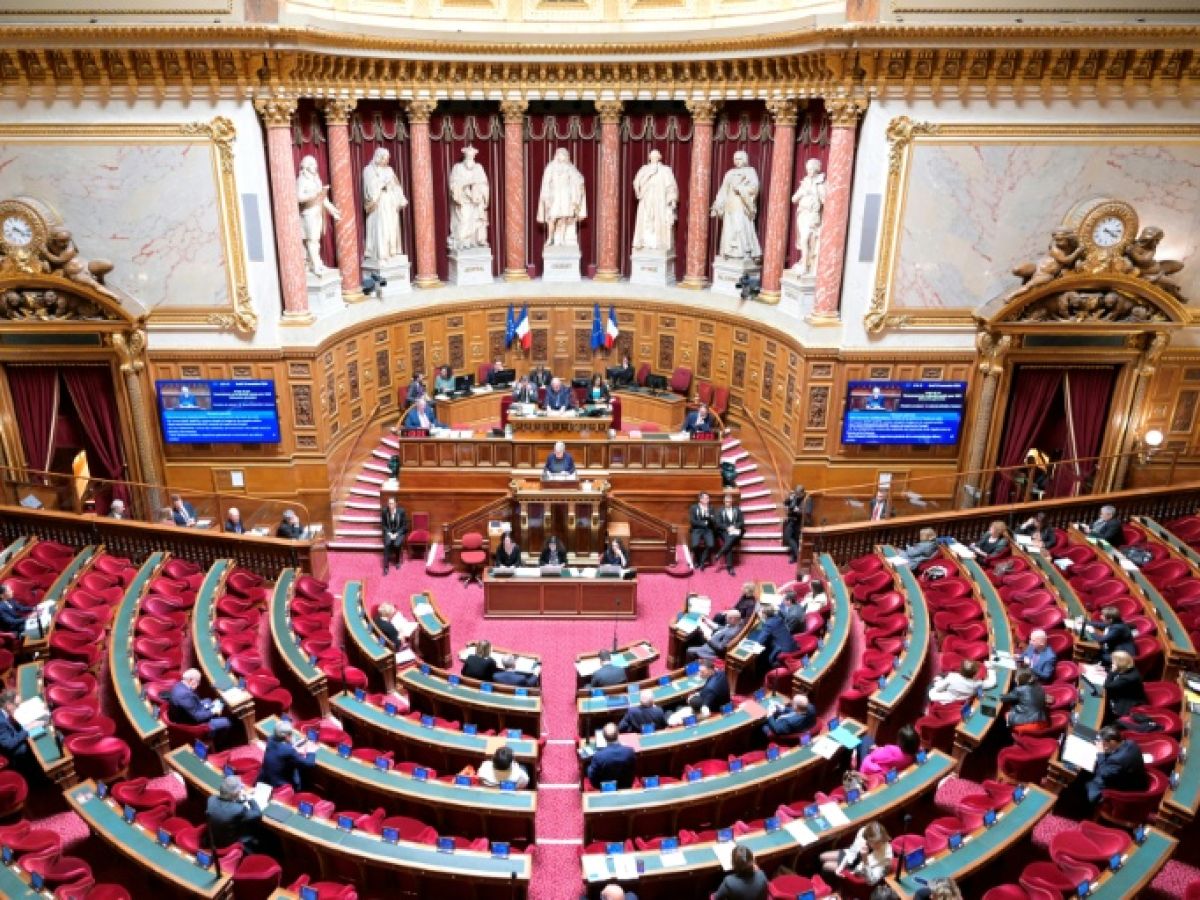
The Senate began its budget marathon on Wednesday with the examination of the Social Security budget, an opportunity for the right to hammer home its inflexible opposition to the suspension of pension reform, at the risk of destroying any chance of a final compromise in Parliament.
After several weeks of sometimes chaotic debates in the National Assembly, the spotlight is now on the Luxembourg Palace.

The senators have taken up the draft social security financing bill (PLFSS). They will later turn their attention to the state budget, currently being debated in the National Assembly. They will sit continuously for seven days on the first bill, before a formal vote scheduled for Wednesday, November 26.
Unlike the Assembly, the upper house has a very clear majority committed to an alliance between the right and the centrists.
This configuration therefore makes it possible to calmly consider a favorable vote, provided that all 1,100 or so amendments submitted to the chamber are successfully addressed…
But which copy will be chosen? Very irritated by the government's choice to turn to the Socialist Party in order to negotiate its survival, the Senate majority does not intend to enter so easily into the "compromise" desired by Prime Minister Sébastien Lecornu.
"The government wants to buy at any price to last a little longer," complained Bruno Retailleau, the leader of the Republicans, who has returned to his position as senator, on Tuesday.
– “Cleaning up” –
Right-wing and centrist parties will therefore have no qualms about rejecting outright the major concession offered by the government to the socialists: the "suspension" until January 2028 of the pension reform raising the legal retirement age to 64.
"In the current context, the government believes this is a measure to stabilize the country," argued Labour Minister Jean-Pierre Farandou.
But "we are not here to maintain a government at all costs," insists the head of the LR group, Mathieu Darnaud. "We know very well that suspending this reform means additional costs," he adds.
Pension reform is not the only point of disagreement between members of parliament and senators, the latter having promised to remove dozens of measures voted on in the Assembly.
"The budget submitted by the National Assembly is not acceptable as it stands. It is up to our high assembly to clean house," said centrist senator Jocelyne Guidez.
The general rapporteur of the text, Elisabeth Doineau, hopes to reduce the Social Security deficit to around 17.5 billion euros in 2026 – the government's initial target – compared to more than 24 billion according to the MPs' copy.
"The social security deficit cannot exceed 20 billion euros," repeated the Minister of Public Accounts, Amélie de Montchalin.
The senators thus intend to reintroduce the principle of the "blank year", that is to say the freezing of retirement pensions and social benefits, with the exception of the allowance for disabled adults (AAH) and pensions below 1,400 euros.
They also oppose the increase in the CSG on capital, another victory for the socialist deputies.
– “The return of horrors” –
"It's the return of the horrors," despairs the president of the socialist senators Patrick Kanner, promising "debates as tough as in 2023 on pension reform."
In this chamber where La France insoumise has no parliamentarians, the left – socialist, ecologist and communist – has promised to “enter into resistance” and to “stand together”, despite its strategic differences on the budget.
"Gone are the days when the Senate was seen as the temple of compromise and republican moderation," lamented Cécile Cukierman, president of the Communist group, as she unsuccessfully defended one of the three motions that aimed to reject the text outright, which she considered one of the "worst" Social Security budgets "since its creation."
In both the Senate and the National Assembly, the vast majority of parliamentarians are already anticipating the failure of the joint committee (CMP), a meeting intended to reconcile the versions of the two chambers at the end of November.
This would force MPs to hastily begin a "new reading" of the Social Security Financing Bill. There is an increasing risk that the text will be implemented by decree if the constitutional deadlines – set for midnight on December 12 – are missed.
 English
  French