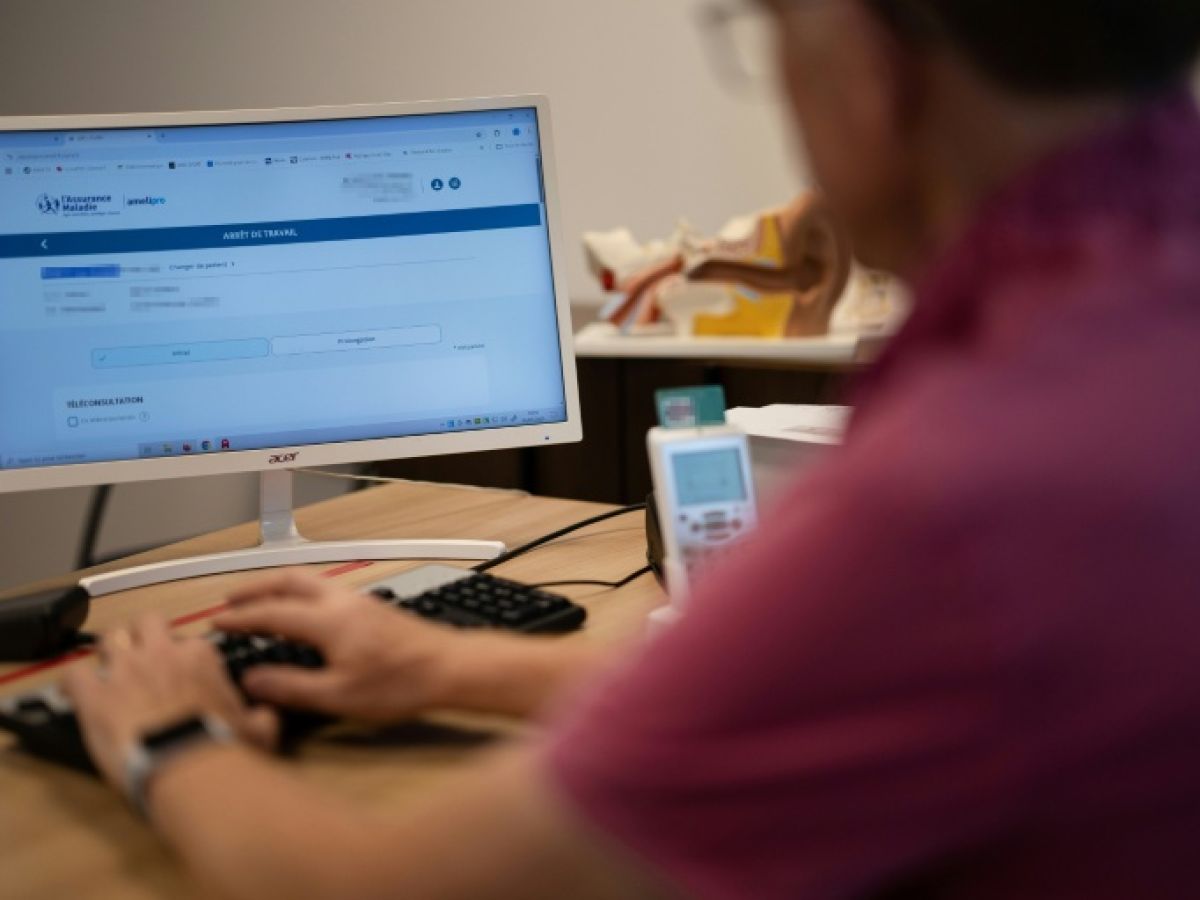
"Old-fashioned", "not ergonomic", "sometimes buggy", "incomplete"... the shared medical record (DMP), intended to store all the medical information of a social security beneficiary, is one of the targets of the current anger of liberal doctors, but the administration promises that it is close to finally fulfilling its promises.
An article in the draft Social Security budget for 2026, which has just been adopted by Parliament, has sparked outrage among general practitioners: practitioners who do not share their prescriptions, reports, referral letters and other documents concerning their patients in the DMP will face fines of up to 10,000 euros per year.
Practitioners may also be required to consult their patient's DMP before prescribing "particularly expensive procedures or in case of risk of misuse", under penalty of incurring a fine of up to 10,000 euros per year.
"Imposing obligations or sanctions on doctors without giving them the appropriate technical means is unacceptable," denounces the CSMF union, in unison with other representative organizations.

The shared medical record is the fundamental building block of Mon Espace Santé, the digital health record of the French.
In fact, this long-standing issue that the State has been trying to implement since a 2004 law still has a long way to go, according to doctors interviewed by AFP.
"With the DMP, we have the impression of going back ten years with a software that is quite old-fashioned, whose ergonomics are not necessarily very pretty, which sometimes has bugs... there are days when it works, days when it doesn't work, we don't know why," laments Dr. Thomas Maunoury, a general practitioner in the North.
"Even for someone experienced, it takes 30 seconds" to connect, laments the practitioner, who uses the DMP "once or twice a day".
"And when we open it, we are often a little disappointed, it's like a book with many blank pages," he laments, adding that too many caregivers are not yet contributing to the tool.
Dr. Jean-Jacques Fraslin, a general practitioner in Loire-Atlantique, also wants improvements, even though he himself consults his patients' DMP very regularly, "10 to 15 times a day".
Automatic data feeds often create "a huge mess". "It takes a lot of time to find the interesting documents, lost among others of no interest," he explains.
– 64,000 users –
"One could imagine that there is an AI that is asked the question 'give me the latest cardiology report of the patient', and that would go and search through all the pdf (files)," he said.
"The date for any sanctions (for not filling out the DMP) is set for 2028! We have time to work on it" with professionals, stressed Health Minister Stéphanie Rist in the Quotidien du Médecin, wishing to make the tool "more ergonomic, simpler to access and more complete" to "encourage" filling it out, rather than forcing.
For its part, the digital health delegation (DNS) assures that the Ségur du numérique en santé, a 2 billion euro investment program financed by the European Union, is now fully making its effects felt on the DMP.
The program notably funded a massive effort to update hundreds of software programs used by healthcare professionals so they could automatically populate the DMP (Digital Medical Record) and facilitate access. Today, 64,000 healthcare professionals have already used the DMP.
Now "70% of the referral letters produced at the hospital" upon the patient's discharge are filed there, as well as "35% of the biology reports", and "45% of the radiology reports", Claire Vigier, one of the project managers at the DNS, told AFP.
From mid-2026, the professional software used daily by doctors will offer "easy, intelligent access" to the DMP, she said.
The next step, which the DNS is working on with the Health Insurance, will be to use AI to generate a "personalised summary" of the file with simple queries like "find me the latest biology report", she explains.
 English
  French