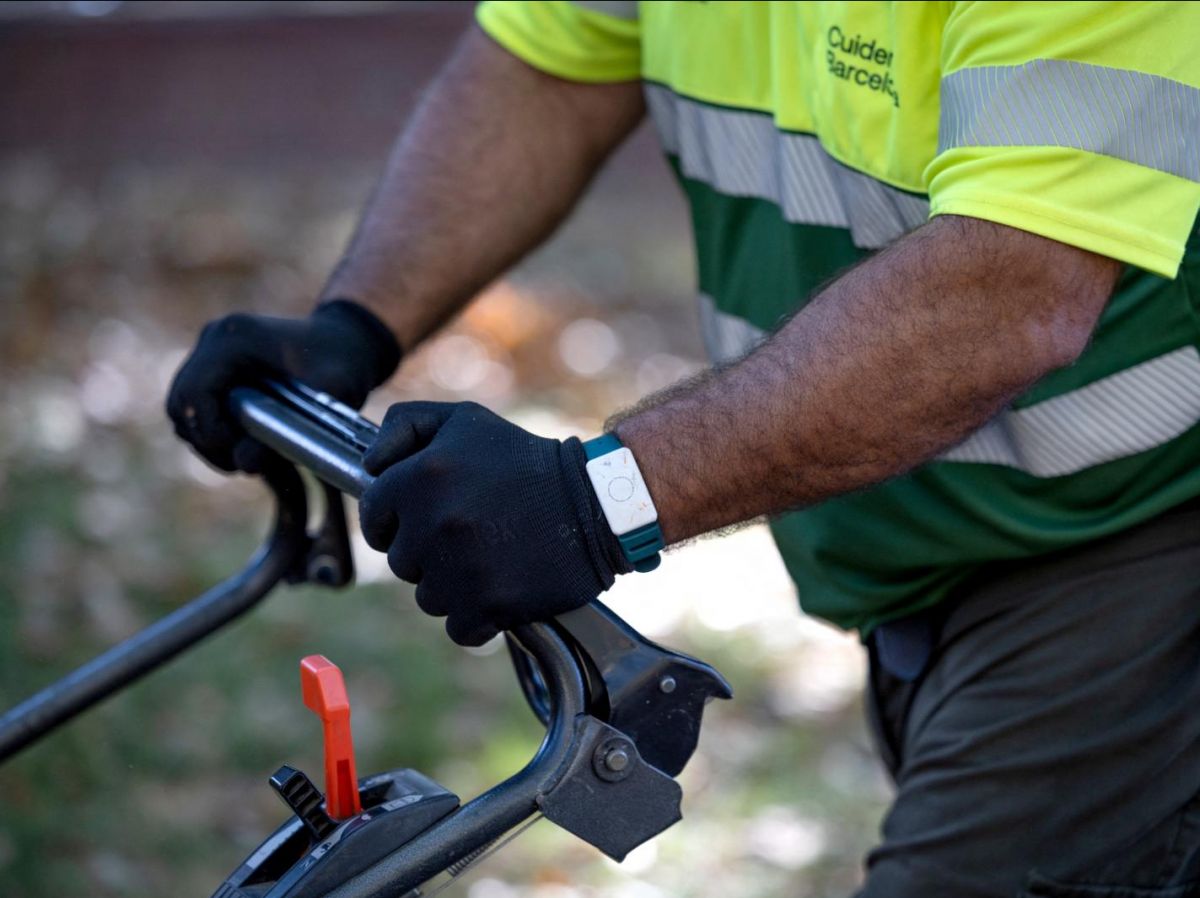
It's not yet 10:00 AM in Barcelona and the sun is beating down on Antonio Reina, who is busy maintaining a public garden. On his wrist is one of the 1,400 thermal bracelets that the city council has distributed to its employees working outdoors.
These devices, which resemble a digital watch without a screen, are equipped with a body temperature sensor that alerts with a red light and an audible signal when the worker approaches dangerous values that could lead to heatstroke.
Faced with the increasing frequency and accumulation of heat waves, Spanish authorities and businesses have adapted working conditions in recent years to protect employees, to the point of sparking interest and debate in France during the June heat wave, around the " Spanish model“.
The bracelet is "an additional security element"“,” says Antonio Reina, the 54-year-old maintenance worker interviewed by AFP: Since it's supposed to sound before you experience symptoms (of heatstroke), it allows you to leave your work area, drink water, and get into the shade.“.
In addition to this innovative gadget, the working hours of these municipal employees have been brought forward and shortened. They also follow a daily protocol that includes regular breaks to hydrate, have access to cooling caps, and never work alone.
The day begins "Earlier, as early as 7:00 AM, because we absolutely must stop at 1:00 PM."
In Madrid, where heat waves regularly push temperatures to around 40ºC in the summer, the workers at Eli de Sousa's company, which installs solar panels, begin the day " earlier, from 7:00 AM, because we absolutely must stop at 1:00 PM.“.
After, " it is impossible to work"r," assures this 41-year-old Brazilian boss. At their workplace, his employees have access to"A small cooler to stay hydrated at all times," and if "the heat becomes too much" intense, " We stop and try to make up for the (work) time another day" he explains.
Several times each day, " We need to go downstairs to cool off a bit, to hydrate ourselves." explains Juan Carlos Rodríguez, who installs equipment on roofs, referring to the measures taken by the telecommunications company that employs him.
Since the 1990s, Spanish legislation has defined a framework for work in the event of extreme heat, stipulating in particular that the temperature in enclosed spaces must not exceed 27°C – a rule which is not systematically respected, however, particularly in schools.
The death of a street cleaner in Madrid in 2022 raised awareness of the dangers of extreme heat.
The death in 2022 of a street cleaner in Madrid from heatstroke in the street, "mobilized the population, society and also the government“ also emphasizes Carmen Mancheño, head of occupational health within the Workers' Commissions (CCOO) union.
Following this, regulations were adopted in 2023 requiring employers "to adjust working hours to avoid tasks being carried out outdoors during the hours when exposure (to heat) is highest"she reminds us.
This regulation also requires the implementation of a special protocol in the event of orange and red alerts issued by the national meteorological agency for extreme heat.
However, "hold firm" remains the implicit instruction.
In practice, this directive is mainly applied in the construction and public works sector and urban cleaning services, but little "However, in other sectors of the industry," the union representative acknowledges.
And the climate leave, introduced following the deadly floods of 2024 in Valencia, which allows people not to come to work in the event of weather phenomena deemed unfavorable, is, according to her, difficult to implement in practice, because, in principle, a heat wave does not prevent people from going to their workplace.
Under these conditions, the best option remains " drink water, spray your face and hang in there“,” sums up Fernando García, 64, who opens his ice cream kiosk every day on Gran Vía, Madrid’s main thoroughfare, even when the heat is stifling. In the 21st century, no one should fall ill or die at their workplace."l," Labour Minister Yolanda Díaz recently emphasized.
The fines imposed by his ministry on companies for heat-related offenses reached almost 1.6 million euros in 2025, nearly double that of 2022. A sign that there is still work to be done.
 English
  French