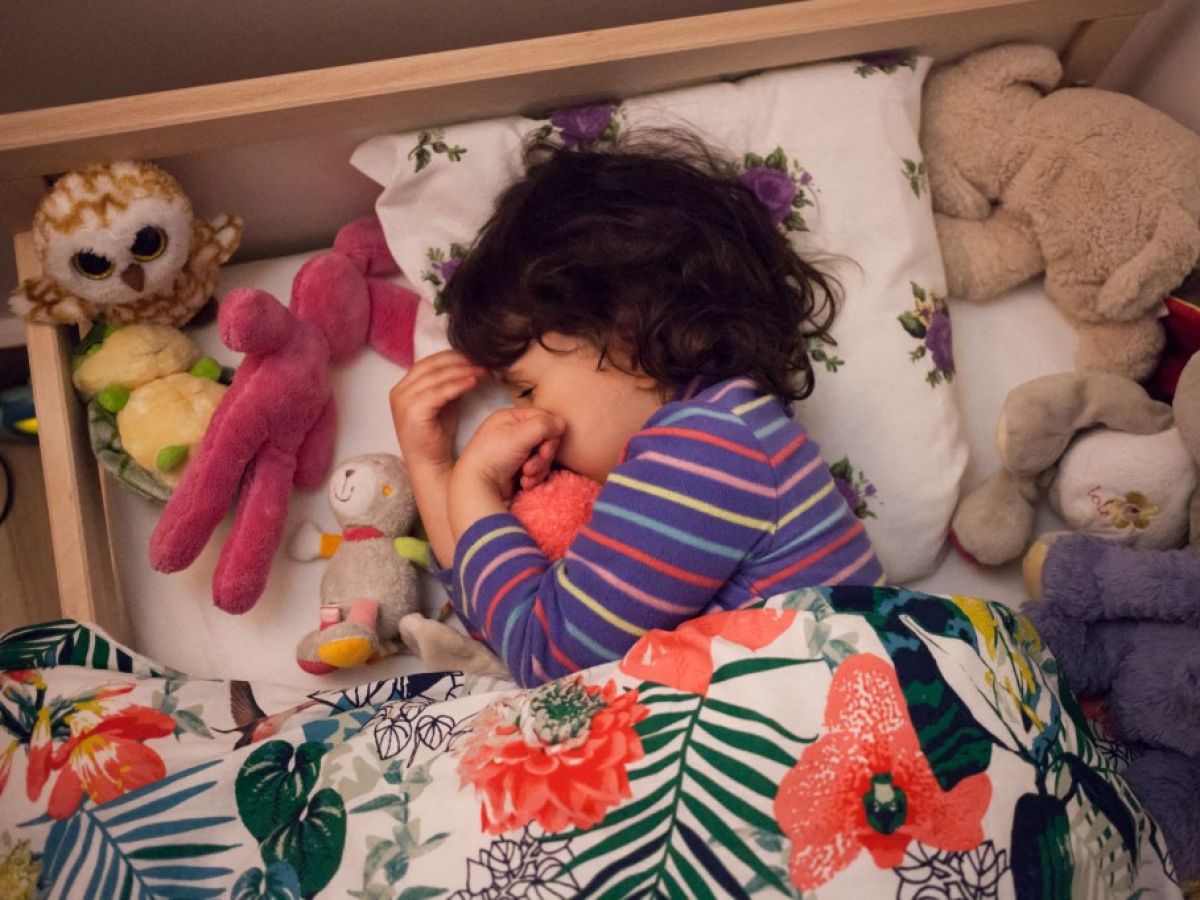
"Why is it that when you put children to bed later, they get up earlier the next morning?""What is the best question?" asks Annick Perrault on our Facebook page. This is our reader question of the week. Thank you all for your participation.
It's a scene many parents have experienced: putting their children to bed later, thinking they'll sleep longer… And, inevitably, they wake up even earlier the next day! A paradox? Only seemingly so. The key lies in the intricate mechanics of sleep and the very precise workings of children's biological clocks, as we explained in a previous article entitled " The five stages of sleep“.
The child has an inflexible internal clock
In children whose sleep-wake cycle is already established (from around one year old), sleep is governed by an internal clock – the suprachiasmatic nuclei, located in the hypothalamus – which gradually synchronizes itself to a 24-hour circadian rhythm, synchronized by light, meals, and daily routines. By around one year old, this system is already well established: the child sleeps mainly at night, with deeper sleep at the beginning of the night and lighter phases in the early morning, just like in adults.
This clock, however, does not tolerate late shifts well. Contrary to what one might think, going to bed later does not mechanically postpone the time of waking up: the biological signal of the morning – carried in particular by light – continues to act at the same time.
Less deep sleep… and an earlier awakening
Another crucial element is sleep structure. In children, deep slow-wave sleep, the most restorative, occurs at the beginning of the night. Delaying bedtime shortens this essential phase without prolonging morning sleep. As a result, the body, less well-rested, paradoxically becomes more unstable towards the end of the night, a period when micro-awakenings are already more frequent between six months and four years of age.
Waking up early is therefore not a "whim" of course: it is the consequence of more fragmented and less deep sleep, which makes the child more sensitive to wake-up signals (noise, light, hunger).
Read alsoWhy do some children stop napping at age 3, while others continue until age 6?
Regularity, sleep's best ally
Therefore, the quality of rest depends more on the regularity of sleep schedules than on occasional extensions. Putting a child between the ages of 1 and 10 to bed later does not create a "bonus" of sleep. On the contrary, it disrupts their still-developing sleep-wake cycle and often leads to early morning wake-ups. And to increased fatigue the next day for the child… and their parents.
 English
  French