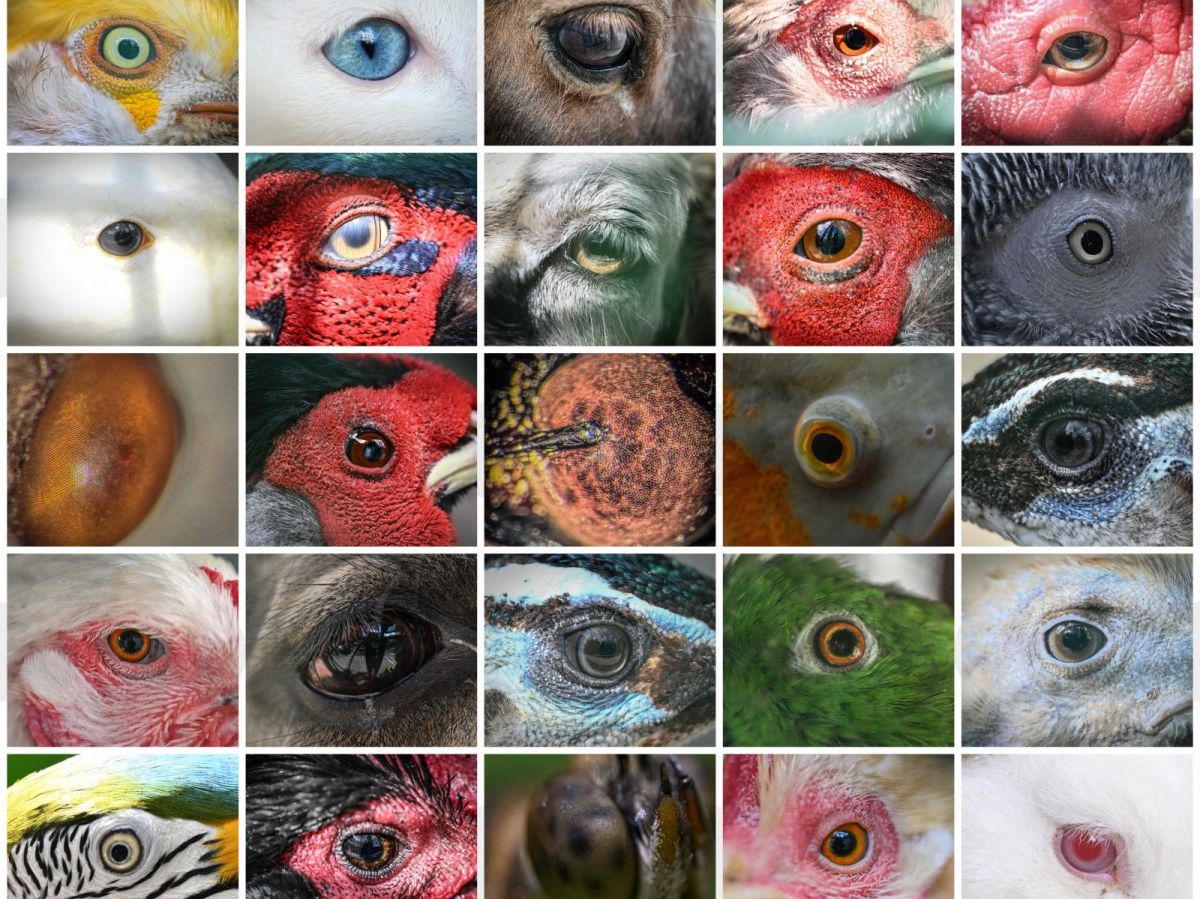
"Is color perception universal across all animal species?"Alpha Yeni asks us this question on our Facebook page. It's our reader question of the week. Thank you all for your participation.
Imagine a vibrant poppy in a field. To our eyes, it's a uniform, almost ordinary red. Yet, for a bee searching for nectar, this flower is something else entirely: a luminous target, adorned with ultraviolet patterns invisible to us. This simple difference encapsulates a fascinating reality: color is not an absolute property of the world, but a biological construct, unique to each species.
A richness in the human retina that remains rare in animals

It all begins in the retina, the thin membrane lining the back of the eye. In humans, two types of cells capture light there: rods, specialized for night vision, and cones, responsible for color perception. Cones are divided into three categories, sensitive to blue, green, and red, respectively. This "trichromatic" system allows us to distinguish a wide range of colors.
But this richness is not the norm in the animal kingdom. Most mammals (including dogs and cats) possess only two types of cones, sensitive to blue and green. As a result, they perceive shades of red poorly, or not at all. "It's often said that they are colorblind, but it would be more accurate to say that they cannot see red." highlighted in 2024 in a previous article of Science and Future Robert Johnson, a researcher at Johns Hopkins University (USA), explains why a red toy might appear greyish to a dog, while a blue ball appears clearly.
The key role of a protein

Behind these differences lies a subtle molecular distinction. Green and red cones are almost identical: their genes share 96 % of similarity. What distinguishes them is a protein, opsin, which determines the wavelength of light absorbed. M-opsin corresponds to green, L-opsin to red.
For a long time, scientists thought that the differentiation between these two types of cones was due to chance. study published in 2024 in the journal Plos Biology The work of Robert Johnson's team has overturned this idea. By cultivating human "mini-retinas" – organoids – for nearly 200 days, the researchers observed that this process actually obeys a precise orchestration.
At the heart of the mechanism is retinoic acid, a derivative of vitamin A. Present early in development, it promotes the formation of cones sensitive to green. Then, as its level decreases, the retina produces more cones that detect red. A veritable "biological timer," controlled in part by a specific gene, thus ensures the proper balance between these cells.
Why did this ability to see red appear in humans and some primates (chimpanzees, gorillas, etc.)? One commonly put forward hypothesis This relates to food. Distinguishing ripe fruits (often red or orange) within vegetation would have been a major evolutionary advantage. This sensory refinement sets us apart from many animals, but it doesn't place us at the top of the visual hierarchy. Other species perceive dimensions that are completely beyond our grasp.
Seeing the invisible
Bees, for example, are sensitive to ultraviolet light. Where we see a uniform surface, they detect complex patterns that guide their search for nectar. Many birds (tits, American robins, etc.) also possess this ability, and some go even further, perceiving up to four or five color channels.
To better understand these perceptual worlds, researchers from the universities of Sussex (UK) and George Mason (USA) have developed a camera system capable of simultaneously capturing visible and ultraviolet wavelengths. Published in 2024 in the magazine Plos BiologyTheir method allows them to reconstruct colors as animals perceive them, with an accuracy greater than 92 %. These images reveal an unsuspected world where visual signals play a crucial role in communication, camouflage, and reproduction. Discover more in the video below.
A very personal vision, from one human being to another
Surprisingly, even in humans, color perception varies. By mapping the retinas of 700 people, the Johns Hopkins team showed that the proportion of red and green cones differs significantly from one individual to another, without significantly altering vision. Thus, a tennis ball may appear more yellow to some, more greenish to others. This variability reminds us that our perception of the world is always an interpretation, shaped by our biology.
This research opens up medical perspectives. By mastering the mechanisms that govern the formation of photoreceptors, researchers hope to be able to grow artificial retinas and, ultimately, restore vision in patients with eye diseases. "We have only scratched the surface of our understanding of photoreceptors," Robert Johnson acknowledged this in 2024. Because the human retina contains more than 100 different cell types! Ultimately, the question isn't just why we see certain colors that other animals don't. It's also the reverse: how many nuances of the world still elude us?
 English
  French