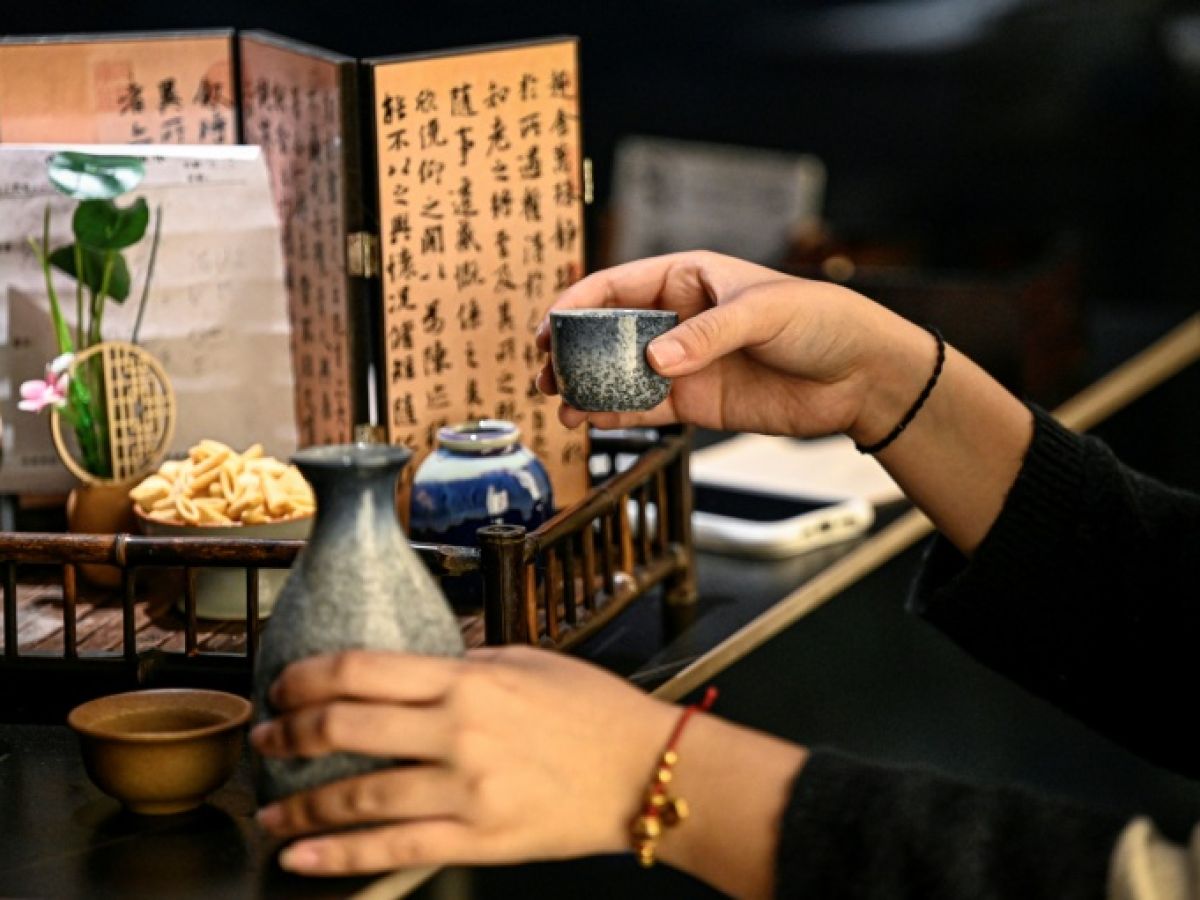
In a dimly lit Shanghai bar, Helen Zhao has her pulse taken. This information is essential so that the bartender can prepare a personalized cocktail for this student, inspired by traditional Chinese medicine.
This type of establishment has multiplied in several cities, riding a trend that young Chinese people ironically call "punk lifestyle" — or the art of indulging in excesses while compensating for them with restorative treatments.

At the "Niang Qing" bar in Shanghai, a doctor in a white coat diagnoses customers' health by taking their pulse. Then, an expert bartender creates bespoke cocktails for them, incorporating herbs and roots from traditional Chinese medicine (TCM) into the alcohol.

Here, there are no shelves filled with alcohols: the walls are lined with apothecary drawers filled with ingredients like goji berries or angelica roots, whose scents permeate the room.
“This bar, in fact, is an opportunity for me” to monitor my health, says Helen Zhao, 26, who says she has a “typical young person” lifestyle, made up of nightlife and junk food.
"Basically, I like to have a drink after work. Here, I can also check if I have a physical problem, while trying to convince myself" that these drinks are good for the body, she explains.

For the bar's resident doctor, Dr. Ding, the concept is not as paradoxical as it seems.
"The association of Chinese medicine and alcohol has a long history in TCM. It used to be referred to as medicinal wine," he says.
He clarifies, however, that the bar aims more to raise health awareness than to offer treatment.
– “Reduce the damage” –
The Chinese labor market is particularly intense and the "996" culture (i.e. working from 9 a.m. to 9 p.m., six days a week) remains widespread.

In recent years, cases of young employees presumed to have died of exhaustion have circulated online, fueling the debate on mental and physical health.
In the "Niang Qing" bar, Cici Song, 41, a service sector executive, says that "late nights are the only real moments that we can fully devote to ourselves."
"But at the same time, we want to take care of our bodies," she adds, sipping an amber drink meant to improve her fragile constitution, recently diagnosed by the bar's doctor.
"It's a kind of balance; you have to have fun while trying to minimize the damage," she jokes.
The formula seems to be appealing.

Founded last year by students from the Shanghai University of Traditional Chinese Medicine, "Niang Qing" already has five establishments in China.
"We have noticed that many young people are interested in TCM, but the ways of discovering it are sometimes boring," explains Wu Siyuan, the 22-year-old co-founder.
The bar was created to allow people to discover traditional medicine "through entertainment," he emphasizes.
– Becoming Chinese –
More broadly, young Chinese people have a growing interest in products that reinvent traditional culture with contemporary codes.

Traditional Chinese Medicine (TCM), in particular, is experiencing a resurgence in popularity worldwide.
On TikTok, the "Becoming Chinese" trend, which involves adopting the Chinese way of life and healthcare, has been all the rage in recent weeks.
She sees foreign internet users preparing herbal infusions, drinking hot water, or practicing traditional physical exercises. A phenomenon that has already garnered hundreds of thousands of "likes".
The “Niang Qing” is also attracting a growing number of foreign clients, according to its founder.
This success is part of an evolution in consumption patterns in China, which are becoming more focused on customer experience rather than material goods.
"Young people are under a lot of pressure and need new spaces to relax," emphasizes Hua Hui, a professor at Shanghai Jiaotong University.
"That's precisely what traditional medicine bars offer: a new opportunity to meet people and improve your well-being, adapted to the spirit of the times."
 English
  French