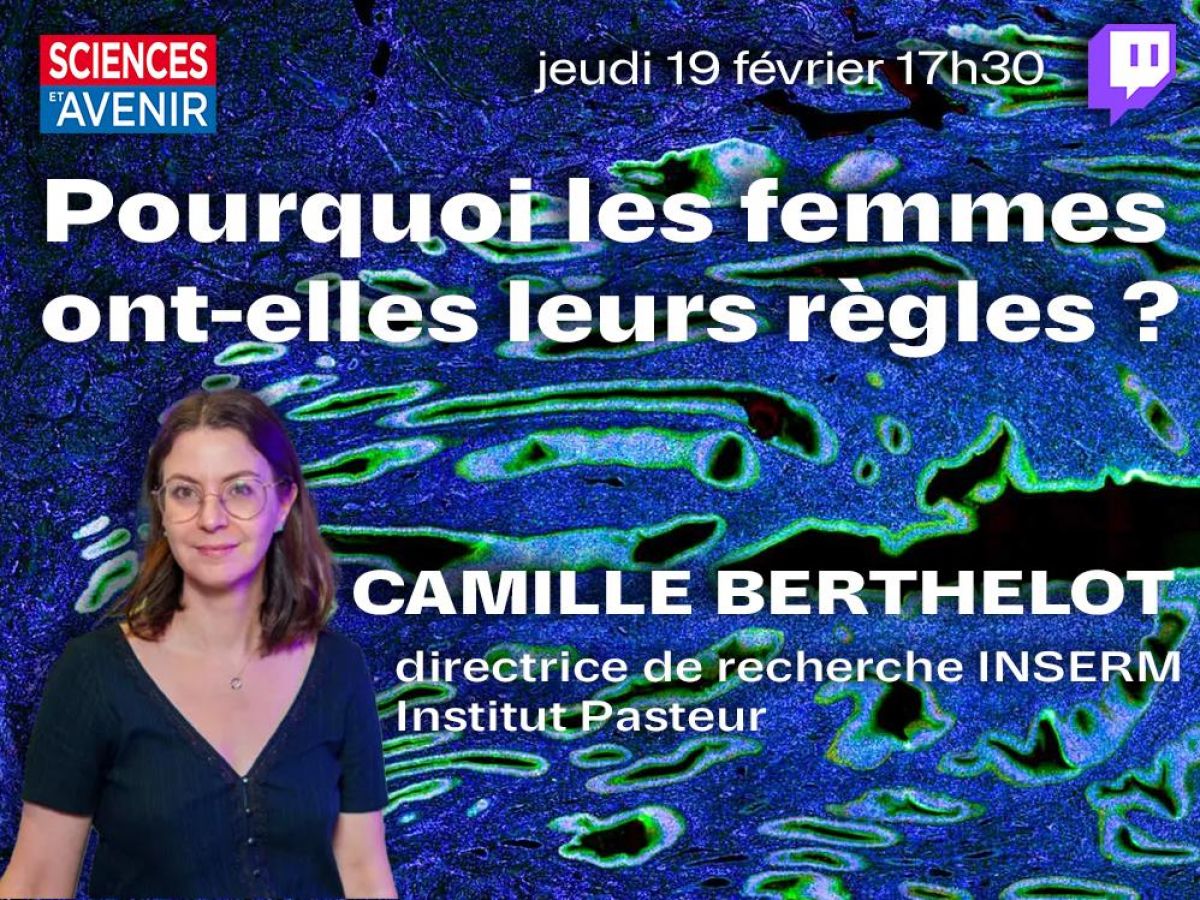
Why do women menstruate? The question seems simple, almost obvious. And yet, many mysteries still lie behind this universal biological phenomenon. Why is menstruation so rare in the animal kingdom? What purpose does it actually serve? And what is its connection to fertility, infertility, or diseases like endometriosis?
To see things more clearly, Science and Future organized a Twitch live stream on Thursday, February 19, 2026 at 5:30 PM, also broadcast live on YouTube. An opportunity, for about an hour, to ask all your questions on the subject to our guest, biologist Camille Berthelot, specialist in genome evolution and the biological mechanisms of the menstrual cycle.
Why do some animal species have periods… and others do not?
Camille Berthelot, a research director at Inserm and head of the "Comparative Functional Genomics" group at the Pasteur Institute in Paris, is interested in a question as intimate as it is fundamental: why do some species, including humans, menstruate… and others not? Contrary to popular belief, menstruation is not a universal phenomenon among mammals. Understanding its origin, its role, and its biological mechanisms sheds light on very current issues in reproductive health.
Camille Berthelot's work is based on an original approach: comparing the genomes and uterine function of primates that menstruate and those that do not. The goal? To identify the cellular and molecular mechanisms that have emerged during evolution, and to understand how the uterus has adapted to embryo implantation, in a subtle compromise between the interests of the mother and those of the embryo.
Endometriosis, a disease that affects one in ten women
This fundamental research also has very concrete applications, particularly for better understanding certain gynecological pathologies such as endometriosis, a chronic disease that is still poorly understood, which affects about one in ten women and may be associated with severe pain and fertility problems.
Winner of the 2025 Impulscience Prize, Camille Berthelot will receive approximately two million euros in funding over five years from the Bettencourt Schueller Foundation endowment fund. This support aims to enable young researchers to develop ambitious and independent research projects, particularly in the field of fundamental research.
On the agenda for this Twitch: Camille Berthelot's journey, the major scientific questions surrounding the menstrual cycle, what research knows — and still doesn't know — about female fertility and infertility, and of course all the answers to your questions on the subject!
Read alsoRules and Moon: The menstrual cycle is influenced by the lunar cycle
Our previous live streams available for replay
Find all our live streams on the YouTube channel of Science and Future :
-
Artemis II, the new conquest of the Moonwith Patrick Michel
-
Einstein's brilliant "mistakes"with Ivan Kiriow
-
Can science save the climate? with Laurent Bopp and Florent Guillou
-
Are women still forgotten by science? with Leila Bessila and Aurélie Brousse
-
Megaliths and their builderswith Florian Cousseau and Tara Steimer
-
Organoids and organs-on-a-chip: the future of medicine? with Fanny Jaulin and Stéphanie Descroix
-
Nuclear fusion, where are we now? with Julien Hillairet and Sébastien Le Pape
-
Seabed, what are the challenges? with Olivier Adam and François Lallier,
-
Video games and mental health: what does science really say? with Michaël Stora
-
Chlordecone: a look back at a public health and environmental issue with Marie Baléo
 English
  French